
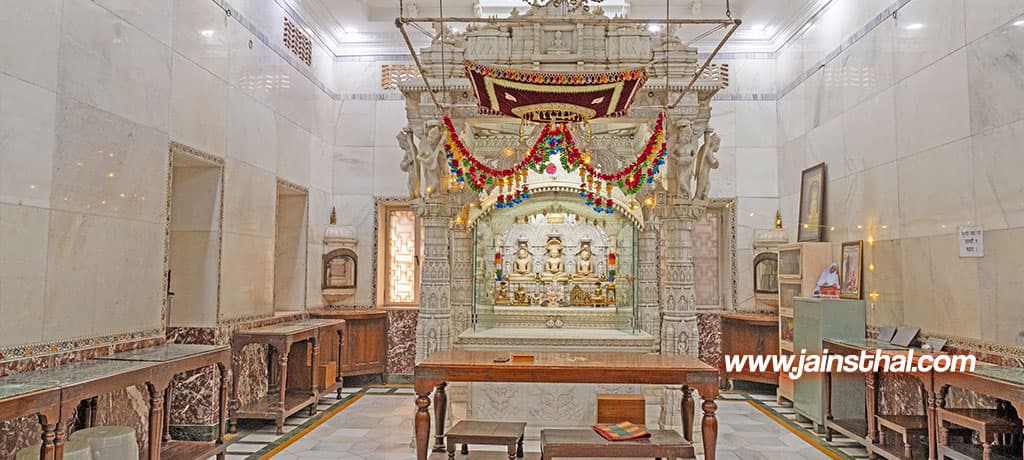
Shri 1008 Khandelwal Chhota Digambar Jain Temple, Vaidwara
Devotees experience a profound sense of divine tranquility upon having darshan of this sacred idol.
Unlike other temples governed by formal committees, this temple is managed solely by the family members and local Jain society. The current active members overseeing the temple's administration are:
Introduction
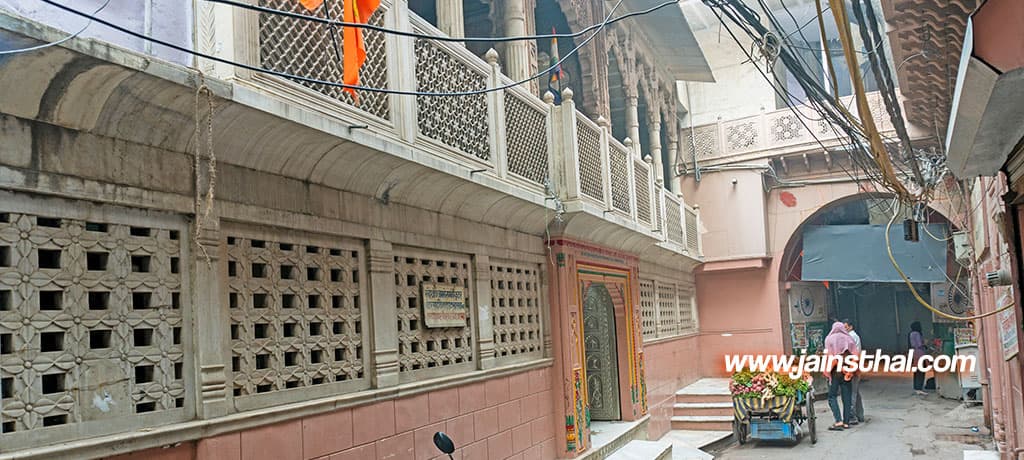
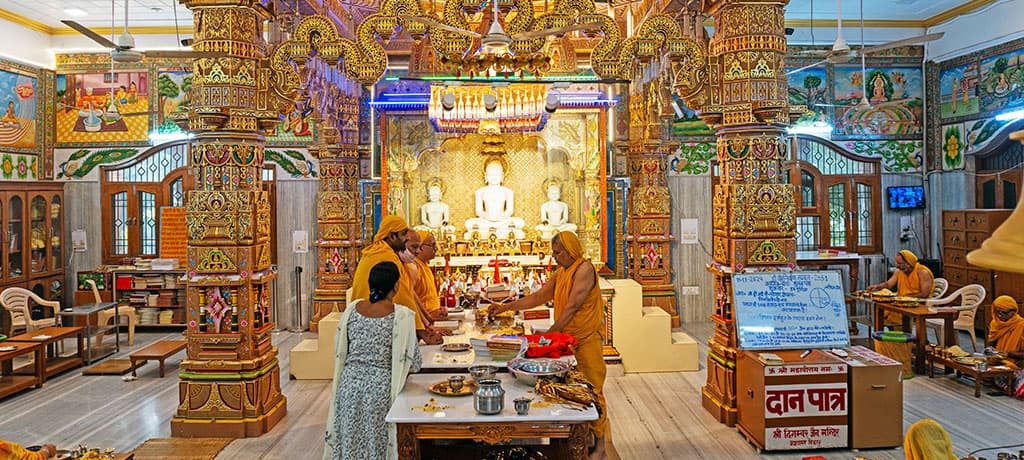
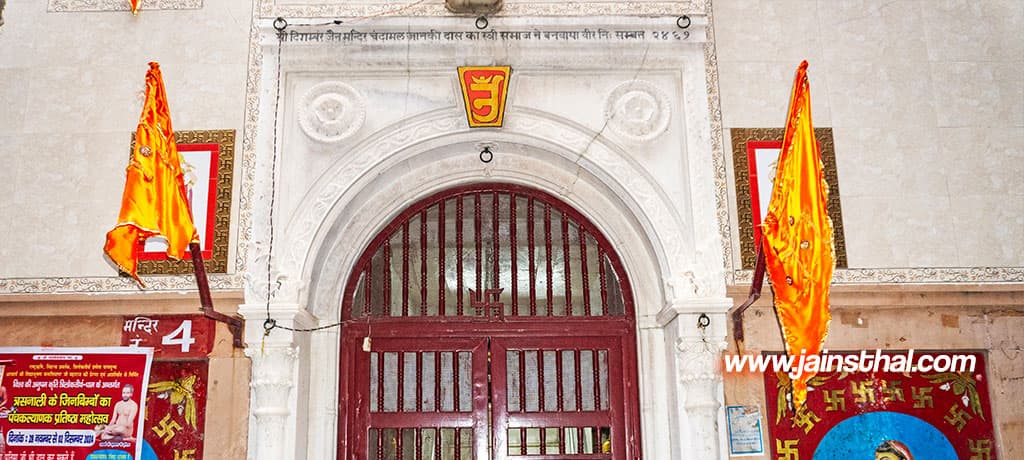
Shri 1008 Khandelwal Chhota Digambar Jain Temple is situated in the Vaidwara area of Chandni Chowk, Delhi. The temple is located within narrow lanes, making it advisable for visitors to park their vehicles near the main road before proceeding on foot for darshan. This historical temple was constructed approximately 150 years ago by Shri Santlal Godha Ji, a respected local resident. The three-story temple is widely recognized for its architectural brilliance and religious significance. Upon reaching the second floor, devotees are blessed with the darshan of the Moolvedi (main altar), which is crafted from pure white marble. The altar is adorned with intricate carvings depicting Jin Bhagwan, Jin Rakshak Dev-Devi, Jain pilgrimage sites, and celestial beings (Indras & Indranis) reverently waving chāmars (sacred fly-whisks) over the Bhagwan’s idol. It is believed that in the past, the Jain community in this region was significantly large. During that time, a gem-studded chhatra (canopy) was suspended above the main altar, further enhancing its grandeur. However, due to a decline in the Jain population, this tradition has gradually faded. The Moolnayak (main deity) of this temple is a Padmasan idol of Shri 1008 Parshvanath Bhagwan, carved from white stone.
“Devotees experience a profound sense of divine tranquility upon having darshan of this sacred idol.”
This idol of Parshvanath Bhagwan is known for its miraculous presence (Atishay) in the region. It is said that whenever a crisis or calamity is about to arise in the surrounding area, the idol of Bhagwan Parshvanath provides mystical signs as a forewarning. Devotees firmly believe that if someone offers prayers with a pure heart and seeks solutions to their problems, Bhagwan’s blessings ensure the resolution of their troubles. A remarkable legend associated with the temple narrates that initially, this idol could not remain stable on the temple’s altar. Each time an attempt was made to place it, some invisible force seemed to prevent its placement. During this time, Param Shraddhey Acharya Shri 108 Desh Bhushan Ji Maharaj arrived at the temple. With his divine vision, he gazed at the idol and proclaimed: "This is no ordinary idol; it is extraordinary and highly miraculous!" After deep contemplation and spiritual meditation, Maharaj Ji decided to install nine precious gemstones beneath the altar. As soon as this sacred ritual was completed, the idol became firmly established in its place, never to be disturbed again. Since then, this idol has remained a symbol of unwavering faith and devotion, continuing to bestow divine blessings upon its devotees. Apart from the Moolnayak idol, the altar houses idols of other Tirthankaras, exquisitely crafted from stone, Ashtadhatu (a sacred alloy of eight metals), and crystal (Sphatik). Among them, the prominent Mukhiya idols are those of Shri 1008 Shantinath Bhagwan and Shri 1008 Chandraprabhu Bhagwan. Additionally, the altar also enshrines a crystal idol of Shri 1008 Mahavir Bhagwan, along with a Choubisi (a representation of all 24 Tirthankaras) and Panch-Balayati idols made of Ashtadhatu. To promote awareness and devotion, a Namokar Mantra recitation paath is held at the temple every month. Furthermore, an annual grand Shobha Yatra (religious procession) is conducted, beginning from the Bada Mandir (main temple) and proceeding to the Chhota Mandir (small temple), where the idol of Shri Ji is ceremoniously enshrined. The procession then continues, completing a parikrama (circumambulation) of the entire area, before concluding back at the Bada Mandir. Even today, devotees associated with the temple actively participate in daily prayers, rituals, and ablution ceremonies, keeping the spiritual essence of the temple alive.
Jain Samaj
Situated at a short distance from this temple in Vaidwara, Chandni Chowk, is the Shri Khandelwal Digambar Jain Bada Mandir. Jain Saintsfrequently visit Chandni Chowk, and their spiritual journey is considered incomplete without darshan at the Shri Khandelwal Digambar Jain Chhota Mandir.
To accommodate Acharya Maharaj and other revered saints during their visit in the Chandni Chowk area, a Sant Bhavan has been constructed, ensuring proper arrangements for their meals and rest.
Additionally, for pilgrims traveling from distant regions, a Dharamshala (guest house) has been built within the temple premises, where accommodation is provided at a minimal charge of ₹100 to ₹150. The Dharamshala also serves as a venue for various religious and social programs.
History
Delhi, the National Capital Territory of India, is a Union Territory and the seat of India’s central government, housing the headquarters of the Executive, Parliament, and Judiciary. Situated on the banks of the Yamuna River, Delhi boasts a glorious historical significance and is frequently mentioned in ancient scriptures and Puranas. Recognized as one of the oldest cities in India, Delhi’s history traces back to the Indus Valley Civilization, with archaeological evidence found in neighboring Haryana. With the rise of the Delhi Sultanate, it became a prominent political, cultural, and commercial hub.
The city features numerous historical and medieval architectural marvels, including Purana Qila, Safdarjung’s Tomb, Jantar Mantar, Qutub Minar, and the famous Iron Pillar. Delhi's earliest mention is found in the Mahabharata, where it is identified as Indraprastha, the legendary capital of the Pandavas. Today, Delhi is not only India’s capital but also a major tourist destination, showcasing landmarks such as the Birla Temple, Katyayani Shakti Peeth, Lal Jain Mandir, Bangla Sahib Gurudwara, Bahá'í Lotus Temple, Akshardham Temple, and Jama Masjid. Moreover, India Gate, a national war memorial, stands as a tribute to fallen soldiers. With its modern infrastructure and booming commercial activities, Delhi has evolved into India’s leading business hub.
Know something about this temple?
Spot something missing or incorrect, or have extra info to share? Let us know and our team will take a look.
Unlike other temples governed by formal committees, this temple is managed solely by the family members and local Jain society. The current active members overseeing the temple's administration are: