
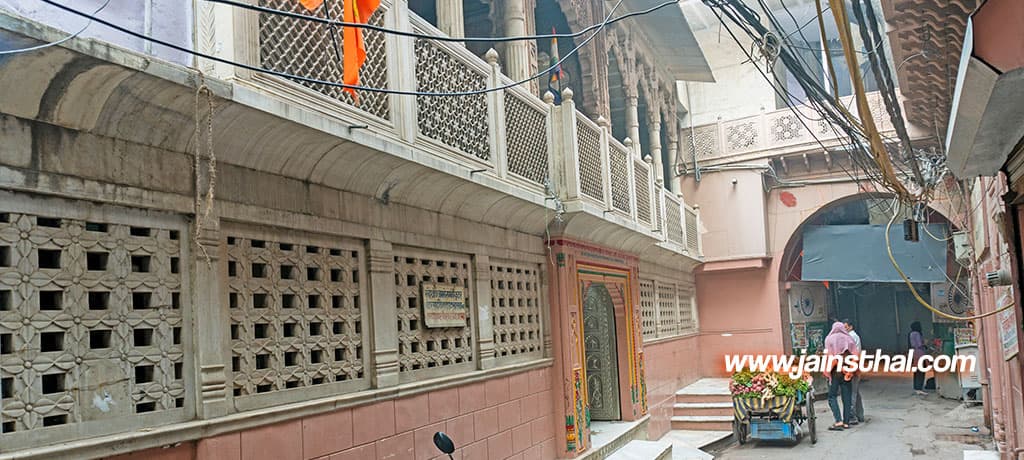
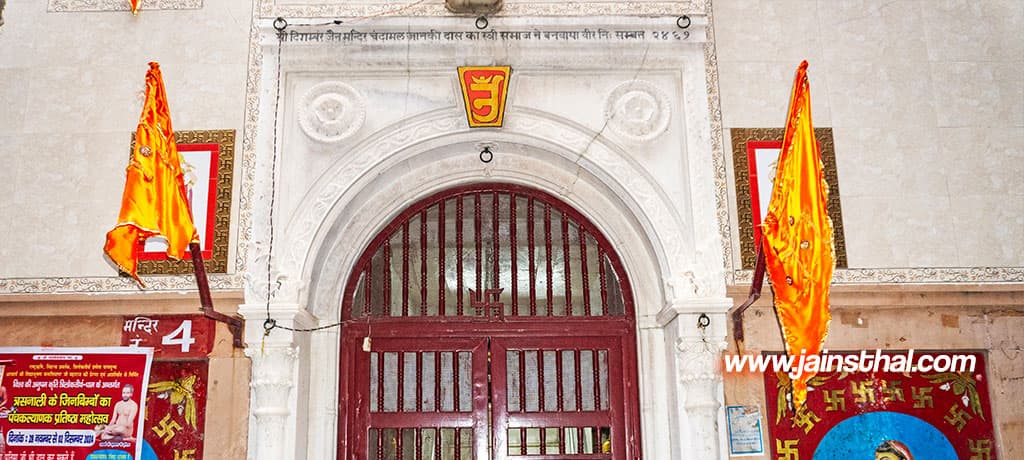
Shri Khandelwal Digambar Jain Mandir, Panchayat Vaidwara
Even today, visitors can see the marks of this miraculous restoration, reinforcing the temple's divine and mystical significance.
To ensure the smooth functioning of the temple, a dedicated temple committee has been established. This committee is responsible for the administration and maintenance of the temple, ensuring that all religious activities and facilities are efficiently managed. The members of the committee are:
Introduction
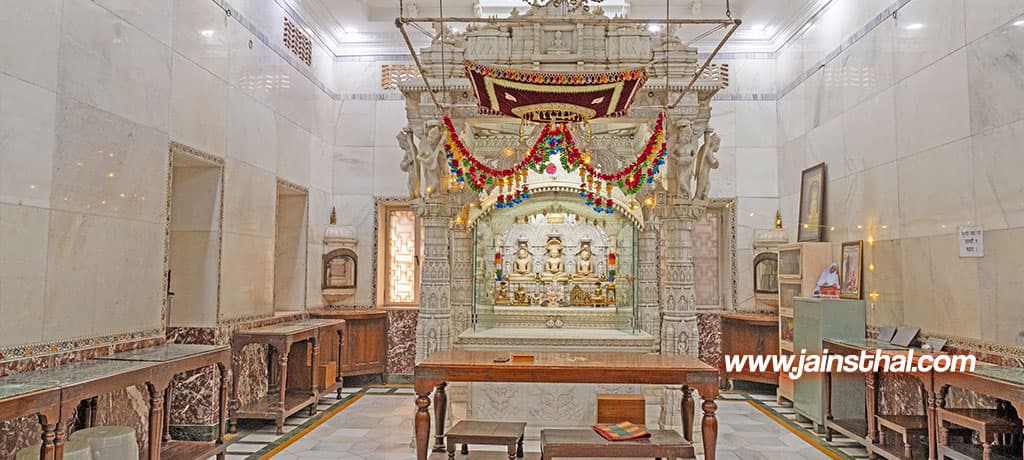
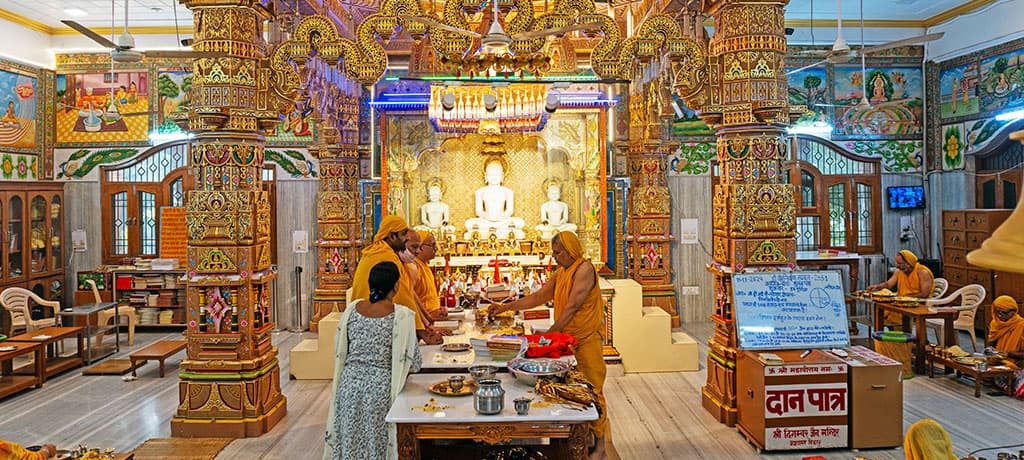
Located in the Vaidwara area of Chandni Chowk, Delhi, Shri 1008 Khandelwal Digambar Jain Temple is renowned for its historical significance and grandeur. Access to the temple is through narrow lanes, so visitors are advised to park their vehicles near the main road and walk to the temple. The architectural brilliance and ancient aesthetics immediately reflect the temple's rich history. It is believed that this temple is even older than the well-known Laal Jain Temple in Chandni Chowk. The three-story temple is famous for its unique architectural style. Upon reaching the second floor, visitors witness a magnificent, ancient Barahdari-style grand veranda, showcasing exceptional craftsmanship. Beyond the veranda lies the sanctum sanctorum, which houses five Vedi (altars) adorned with ancient Jain idols. The main altar enshrines the idol of Shri 1008 Bhagwan Mahavir Swami. Additionally, over 700-year-old stone and Ashtadhatu (a sacred alloy of eight metals) idols are enshrined here. The second altar houses the idol of Shri 1008 Bhagwan Neminath as the Mool pratima (principal deity). The third altar enshrines Shri 1008 Bhagwan Parshwanath. The fourth altar is dedicated to Shri 1008 Bhagwan Padmaprabhu. Each Vedi radiates immense spiritual energy, and many other ancient idols are revered with great devotion. Outside the sanctum, a fifth Vedi (altar) contains idols that are estimated to be between 1,000 and 2,000 years old. It is told that around 25 years ago, during the renovation of Bhagwan Parshvanath’s Vedi, Acharya Shri 108 Pragya Sagar Ji Maharaj visited the temple. He received a divine indication that ancient Tirthankar idols were buried beneath the Vedi’s foundation. Upon excavation, small idols made of Ashtadhatu and stone were discovered. One of these idols was of Lord Parshvanath, whose neck was initially broken. Interestingly, after a few days, the local community observed that the damaged part of the idol had miraculously fused back together.
“Even today, visitors can see the marks of this miraculous restoration, reinforcing the temple's divine and mystical significance.”
In front of the sanctum of Shri 1008 Lord Padmaprabhu, there are two additional altars dedicated to Goddess Padmavati and Kshetrapal Baba. Another altar houses divine ancient idols of Dharanendra Dev and Goddess Padmavati. The idol of Goddess Padmavati is particularly revered for its miraculous powers, and devotees visit to seek her blessings. The temple also holds a rare collection of ancient handwritten Jain scriptures, further enhancing its historical and religious importance. Adjacent to the temple stands Sant Bhavan, specifically built to accommodate visiting Jain saints. Whenever saints visit the area, arrangements for their stay are made here. The Sant Bhavan also enshrines an altar of Shri Shantinath Bhagwan, which includes stone and Ashtadhatu idols of other Jain Tirthankaras. Daily religious rituals such as worship, ablution, and Shantidhara are performed with complete devotion, maintaining the spiritual vibrancy of this sacred place. Due to its historical, religious, and cultural significance, this temple holds a special place of reverence for Jain devotees.
Jain Samaj
Despite a limited number of Jain families residing near the Shri Khandelwal Digambar Jain Temple in Vaidwara, Chandni Chowk, regular worship and religious ceremonies are conducted with full devotion. Jain saints frequently visit the temple, and Sant Bhavan provides appropriate lodging and food arrangements for them.
For devotees traveling from distant locations, a Dharamshala (guesthouse) is available, offering accommodation for a nominal fee of ₹100 to ₹150. The Dharamshala is also used for religious events and social gatherings.
History
Delhi, the capital of India and a Union Territory, serves as the administrative hub housing the nation's executive, legislative, and judicial branches. Situated along the Yamuna River, Delhi has a glorious history with special significance in ancient scriptures. The city’s origins trace back to the Indus Valley Civilization, with archaeological evidence discovered in nearby Haryana. Delhi gained prominence with the rise of the Delhi Sultanate, emerging as a key political, cultural, and commercial center. Today, the city boasts numerous ancient and medieval structures, including historic ruins.
The earliest mention of Delhi appears in the Mahabharata, where it is identified as Indraprastha, the capital of the Pandavas. As India’s capital, Delhi is not only a political center but also a major tourist attraction. In addition to housing government buildings such as Rashtrapati Bhavan, Parliament House, and Central Secretariat, Delhi is home to historical sites like Purana Qila, Safdarjung Tomb, Jantar Mantar, Qutub Minar, and the Iron Pillar. Delhi is also a spiritual hub, featuring prominent religious landmarks such as Birla Mandir, Katyayani Shaktipeeth, Lal Jain Temple, Bangla Sahib Gurudwara, Bahá’í Lotus Temple, Akshardham Temple, and Jama Masjid. India Gate, a memorial dedicated to the nation’s martyrs, stands prominently on Rajpath. Today, Delhi serves as India’s primary commercial hub, playing a crucial role in trade and industry.
Know something about this temple?
Spot something missing or incorrect, or have extra info to share? Let us know and our team will take a look.
To ensure the smooth functioning of the temple, a dedicated temple committee has been established. This committee is responsible for the administration and maintenance of the temple, ensuring that all religious activities and facilities are efficiently managed. The members of the committee are: