
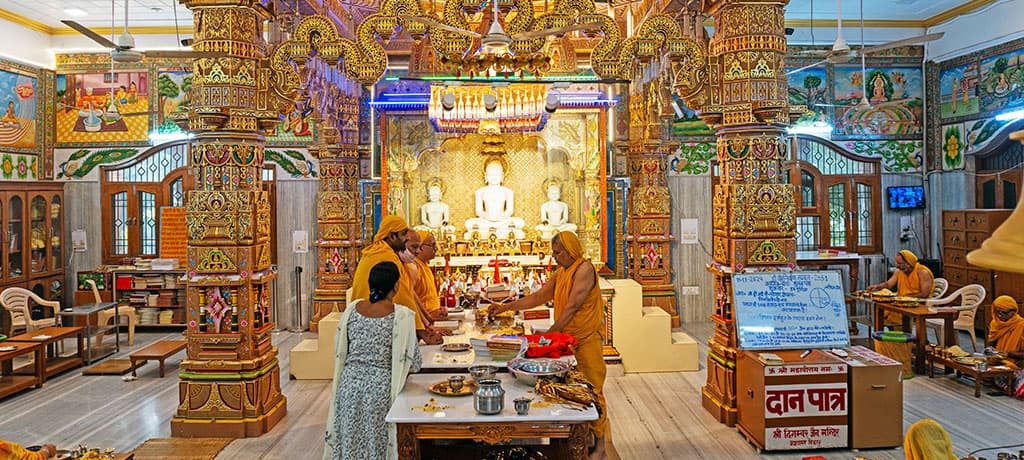
Shri 1008 Mahavir Digambar Jain Temple, Prashant Vihar
Witnessing this miraculous event, the Jain community believed it was a divine sign from Lord Mahavir Swami, protecting the sacred ground.
The Shri Digambar Jain Temple Committee oversees the temple’s smooth operation. The committee members are as follows:
Introduction
Located in the heart of Delhi’s Prashant Vihar, Sector 14, Shri 1008 Mahavir Digambar Jain Temple stands as a magnificent symbol of spirituality and architectural grandeur. Built by the local Jain community, this Shikhar-style temple reflects their unwavering faith and dedication. Before the temple’s construction, a Chaityalaya was established at the residence of Shri Sureshchand Jain in the nearby C-Block. Three sacred idols, consecrated in a different temple, were later brought here, establishing a revered place of worship for the growing Jain community. However, as the community expanded, the need for a grand temple became evident. This led to the acquisition of land and the establishment of a temporary Chaityalaya, where the revered idols from Shri Sureshchand Jain’s residence were respectfully relocated. The vision of a grand temple was finally realized with the completion of Shri 1008 Mahavir Digambar Jain Temple. To commemorate this auspicious occasion, a grand Panchkalyanak Pratishtha Mahotsav (consecration ceremony) was held from April 25 to April 30, 2009, under the divine guidance of Acharya Shri 108 Saurabh Sagar Maharaj. During this sacred event, new idols were also consecrated, further enriching the temple’s spiritual significance. Today, the temple stands as a beacon of devotion, offering a serene space for worshippers to seek inner peace and enlightenment.
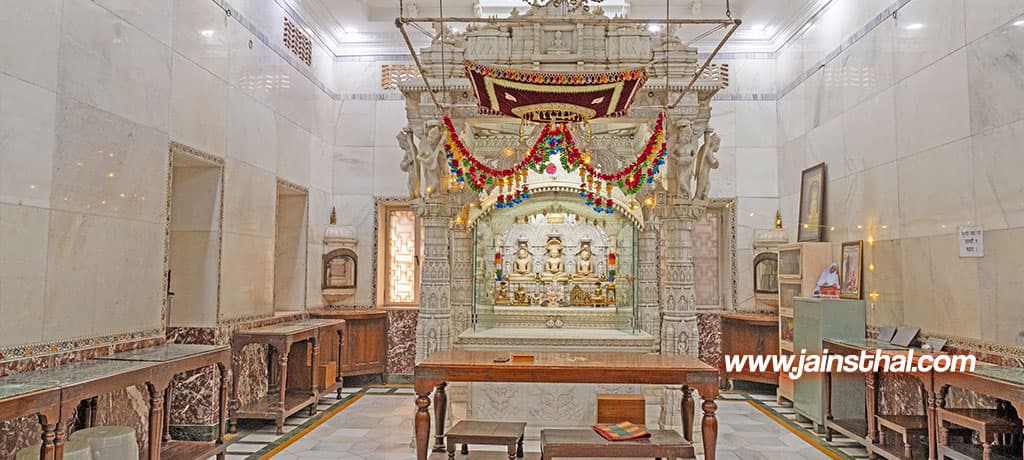
Shri 1008 Mahavir Digambar Jain Temple is home to a single Vedi (altar), which enshrines the Moolnayak Pratima (main idol) - a beautifully crafted stone idol of Bhagwan Shri 1008 Mahavir in the Padmasana (Lotus) posture. By the side of the main idol are two other prominent stone idols of Shri 1008 Adinath and Shri 1008 Chandraprabhu, along with eight newly crafted Ashtadhatu (an alloy of eight metals) idols, further enriching the temple’s divine presence. Adding to its grandeur, the entire Vedi is adorned with exquisite golden craftsmanship, enhancing the temple’s aesthetic and spiritual appeal. The temple also features a dedicated Vedi for Shri Kshetrapal Baba and Mata Padmavati, where devotees offer heartfelt prayers.
Atop the temple’s Shikhar (spire), four sacred idols of Bhagwan Sumatinath, Bhagwan Shitalnath, Bhagwan Shreyansnath, and Bhagwan Dharmnath are enshrined, where daily worship and rituals take place. The temple frequently welcomes revered Jain Saints, whose presence brings spiritual enlightenment to the devoted community. Esteemed spiritual figures such as Shri 108 Saurabh Sagar Maharaj, Shri 108 Pranamya Sagar Maharaj, Shri 108 Viragsagar Maharaj, Shri 108 Sunil Sagar Maharaj, and Aryika 105 Shri Gyanmati Mata Ji have graced the temple with their divine presence. Every day, devotees gather to perform Puja (worship), Abhishek (ceremonial bathing of the idol), and prayers, ensuring an uninterrupted flow of spiritual energy within the temple. More than just a place of worship, Shri 1008 Mahavir Digambar Jain Temple stands as a beacon of faith, devotion, and the unwavering commitment of the Jain community.
Atishay Katha
It is often said that every sacred endeavor encounters its share of challenges, but unwavering devotion and faith can overcome even the greatest obstacles. The journey of constructing the Shri 1008 Mahavir Digambar Jain Temple was no exception but one marked by persistence, struggle, and ultimately, divine intervention. When the foundation for the temple was laid, opposition from some local individuals arose. Several attempts were made to disrupt the construction, yet the Jain community remained steadfast in their commitment to the project, undeterred by the obstacles they faced. One night, as the foundation had been established, a group of disgruntled individuals approached the site with the intent to damage the construction. However, as they drew near, they were suddenly confronted by a massive serpent. The sight of this terrifying creature caused them to flee in fear, leaving the construction site unharmed.
“Witnessing this miraculous event, the Jain community believed it was a divine sign from Lord Mahavir Swami, protecting the sacred ground.”
From that moment on, no further attempts to hinder the temple’s construction were made. The opposition that once threatened the project was silenced, and the temple was completed under the auspices of Lord Mahavir’s blessings. Today, the Shri 1008 Mahavir Digambar Jain Temple stands as a beacon of faith, reminding all that with determination, devotion, and divine protection, no obstacle is insurmountable.
Jain Samaj
To ensure the smooth operation of Shri 1008 Mahavir Digambar Jain Temple, a dedicated temple committee has been established. The committee prioritizes the comfort and convenience of all visitors, striving to offer a welcoming and peaceful experience for every devotee. For Jain ascetics, the temple provides nine air-conditioned rooms for their stay. Additionally, a spacious hall is available for sermons by the revered Jain Saints who frequently visit the temple. A dedicated residence for the Saints has also been constructed to accommodate their needs.
In the temple’s basement, a large hall serves as a venue for organizing communal meals during religious ceremonies, further fostering a sense of community. Beyond its religious activities, the temple committee is deeply involved in social welfare initiatives. It regularly organizes food distribution camps and other charitable works to support the broader community. Currently, the committee is working on the construction of a dispensary to offer medical assistance to those in need, demonstrating its commitment to the well-being of all.
History
The National Capital Territory of Delhi is the capital of India and a Union Territory. As the capital, it houses the headquarters of all three branches of the Indian government—the Executive, the Legislature, and the Judiciary. Delhi is a city of immense historical significance, with roots tracing back to the Indus Valley Civilization. The city flourished during the Delhi Sultanate era, evolving into a political, cultural, and commercial hub. The historical importance of Delhi is reflected in the presence of ancient structures like the Old Fort, Safdarjung’s Tomb, Jantar Mantar, Qutub Minar, and the Iron Pillar. It is also home to various religious sites, including the Birla Temple, Katyayani Shakti Peeth, Lal Jain Temple, Bangla Sahib Gurudwara, Bahá'í Temple, Akshardham Temple, and Jama Masjid, among others.
Know something about this temple?
Spot something missing or incorrect, or have extra info to share? Let us know and our team will take a look.
The Shri Digambar Jain Temple Committee oversees the temple’s smooth operation. The committee members are as follows: