
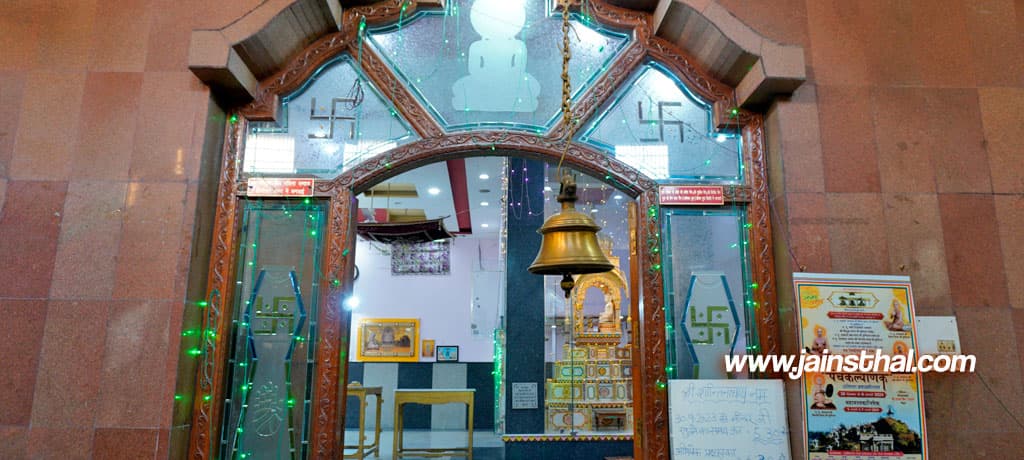
Sonipat Shantinath Atishya Kshetra
In the temple, Atishay (divine occurrence) continued to be observed over time.
The Shri Digambar Jain Mandir Committee has been established for the efficient management of the Shri 1008 Shantinath Digambar Jain Atishay Kshetra. The active members of the committee are as follows :
Introduction
The 1008 Shantinath Digambar Jain Mandir complex is located just 300 meters away from Bada Mandir Ji in Mohalla Chaudharyan, Sonipat. This dates back to 1904 when there used to be a Jain household at the location of the temple. In that house, there lived a woman named Dako Devi and her family. Whenever Dako Devi kneaded dough in the kitchen to make roti, her rolling stone (chakla) would flip upside down on its own. Also many times, Dev appeared in her dreams, indicating the presence of an idol beneath the kitchen floor.
Thus Dako Devi shared the dream with her family members. The sentence was presented before the Jain community of that time. The decision to excavate the underground was made by the Jain community. When the excavation was undertaken, they discovered an ancient idol of Shri Shantinath Bhagwan. The community members brought the idol to Chota Jain Mandir and established it there. After some time, Dako Devi had another dream in which Dev instructed her to establish the idol exactly where it was found during the excavation. Upon sharing this information with the Jain community, they decided to construct a Chaityalaya at that very location.
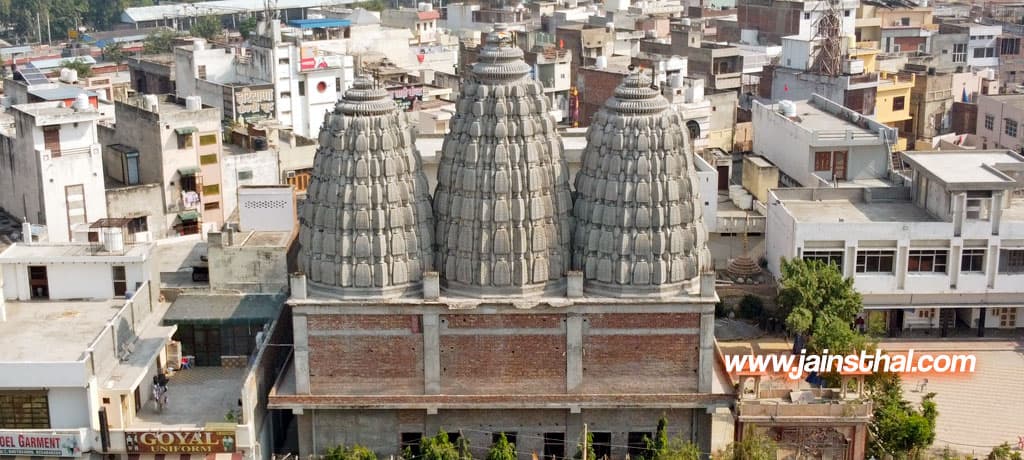
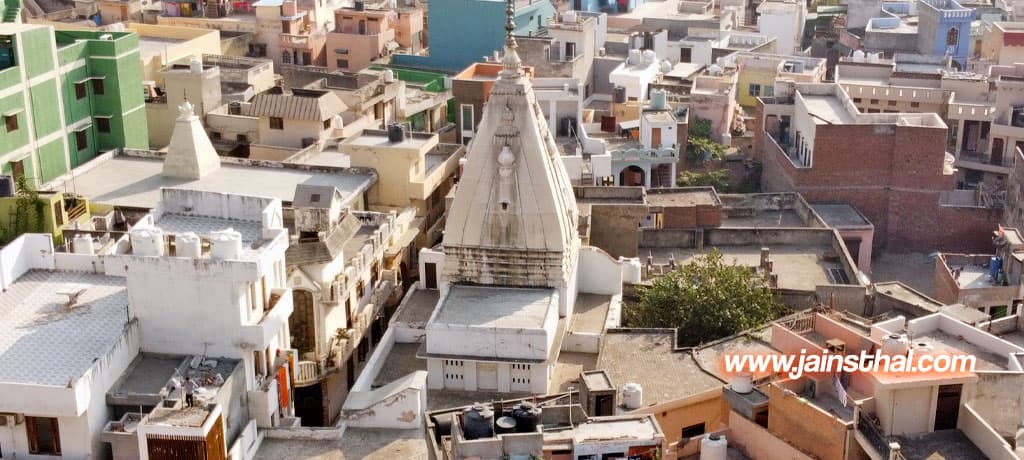
However, whenever construction work for the Chaityalaya was undertaken, they were not able to proceed with the work. Therefore, Dev once again appeared in Dako Devi dream and instructed her that the first donation for the construction of the Chaityalaya should be given by her. Then some amount of money and their house were handed over to the Jain community by the Dako Devi’s family, and thus, the construction of the Chaityalaya was completed. In the years 2001 to 2002, Aryika Mata Padam Ji arrived in Sonipat. She advised the local Jain community to construct a Shikhar (spire) above the Chaityalaya, and thereafter the Jain community constructed a Shikhar above the Chaityalaya, transforming it into a temple. The Moolnayak Pratima (main deity’s idol) in the temple is of Shri Shantinath Bhagwan, revealed from the underground. The Shantinath Bhagwan idol has a lot of significance and Atishya (numinous presence) in the area. Devotees visit the temple daily to have the darshan of the idol.
Atishay Katha
“In the temple, Atishay (divine occurrence) continued to be observed over time.”
In the year 2001-2002, the mother of Acharya Shri 108 Pushpadant Ji Maharaj, Aryika Padam Ji, arrived at the Sonipat Bada Mandir. She had a feeling that an idol had manifested from the depths in Sonipat. She inquired about the idol with the members of the society. The Jain community informed her that nearby, in the house of a Jain family, the idol of Shri Shantinath Bhagwan had manifested from underground. Mata Ji expressed her desire to see the idol. Mata Ji was about 85 years old, and facing difficulty in walking due to her age. She was brought to the temple with the help of a vehicle. As Mata Ji began to place her feet outside the vehicle, suddenly, with a flick, she withdrew her feet back, saying, 'You will touch me.' Upon hearing this, the people standing nearby moved back. Mata Ji's granddaughter who accompanied her explained to the people that she was not speaking to them but to the Dev. Hearing this, everyone present there was astonished. While communicating with the Dev, Mata Ji said, 'First, I will have the darshan of Bhagwan Ji, then I will dance with you.' Saying this, Mata Ji climbed the stairs and reached the Garbh Grah (sanctum sanctorum) to have the darshan of the idol. After having the darshan, she danced like a sixteen-year-old girl. Everyone present there was amazed, thinking that she was having difficulty in walking, yet she could dance like a young girl. This indeed is an Divine Occurrence of Bhagwan Jinendra.
Dharamshala
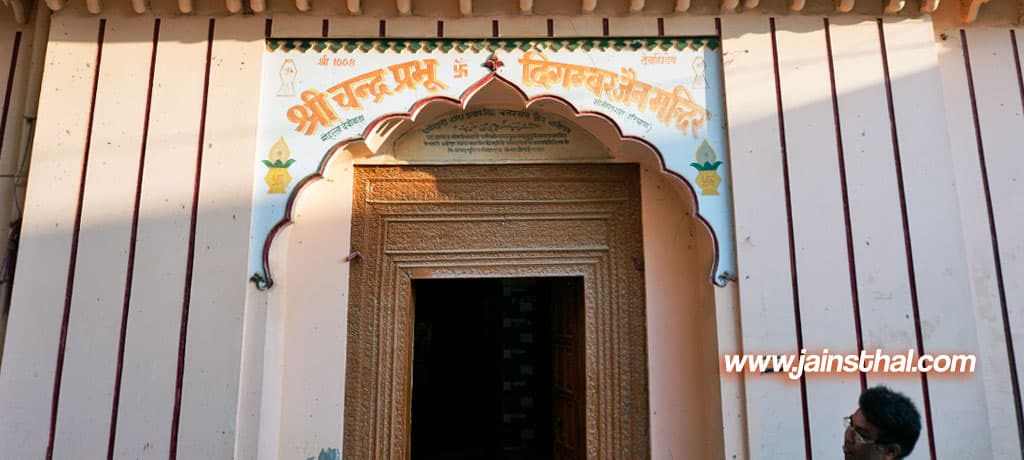
Shri 1008 Shantinath Digambar Jain Mandir at Mohalla Chaudharyan is situated at a distance of 500 meters from Shri 1008 Parshvanath Digambar Jain Bada Mandir at Halwai Hatta. Surrounding the temple, there are approximately a hundred Digambar Jain families residing in the area. In the vicinity, a total of five Digambar Jain Mandir are situated. All these temples are administered by the management of the Shri 1008 Parshvanath Digambar Jain Bada Mandir. Arrangements for the accommodation of pilgrims visiting the temple for darshan have been made. Accommodation for pilgrims is arranged in Seth Chetan Lal Jain Dharmashala and Paras Das Jain Dharamshala. Both dharamshalas have arrangements for ten rooms each. When Jain Muni Maharaj Ji visits the Bada Jain Mandir, arrangements for their accommodation are made in the Tyagi Bhavan. Within the premises of the Bada Jain Mandir, a school has been constructed where education is provided up to the fifth grade to children at a nominal fee. The Jain Vidya Mandir School, constructed by the Jain community, also provides education up to the twelfth grade to children of both Jain and non-Jain communities in Sonipat.
History
Sonipat is a district located in the state of Haryana, India. The name "Sonipat" is derived from the Sanskrit word, meaning "the place of gold". Situated approximately 43 kilometers north of New Delhi, this city was likely founded around 1500 BCE by early Aryans. Sonipat is renowned for its historical significance, being witness to several major events throughout history. It has witnessed three battles of Sonipat, including significant conflicts between the Mughal Empire and Islamic sultans. The strategic location of Sonipat has made it an important historical site. Sonipat is a major city in the district and holds significance from both political and administrative perspectives. Many government and private offices and institutions of Haryana state are located here. Situated on the banks of the Yamuna River, this city has expanded and flourished, now being situated about 15 kilometers eastward from its original location. Sonipat district is primarily an agricultural area, with 83 percent of its land utilized for farming. Wheat and rice are the major crops, while other crops include barley, pulses, sugarcane, maize, sesame, and vegetables. Surrounding the Sonipat, there are many cultural sites of historical and cultural importance, including temples, gurudwaras, and historical sites, which are attractive tourist destinations. The Sonipat region boasts of a rich heritage, showcasing its historical and cultural legacy. There are several archaeological sites and protected areas here that are significant for history enthusiasts.
Know something about this temple?
Spot something missing or incorrect, or have extra info to share? Let us know and our team will take a look.
The Shri Digambar Jain Mandir Committee has been established for the efficient management of the Shri 1008 Shantinath Digambar Jain Atishay Kshetra. The active members of the committee are as follows :