
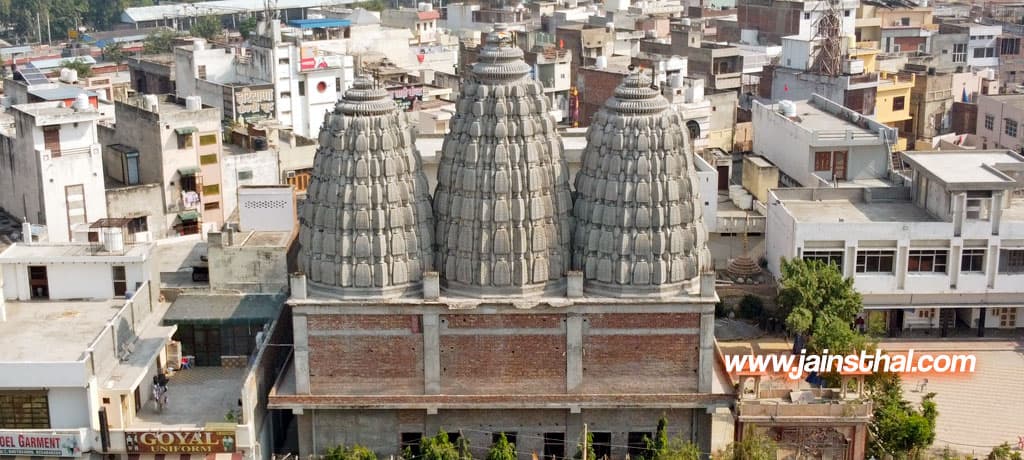
Sonipat Mission Road Jain Mandir
It is believed that the city was founded around 1500 BCE by early Aryans.
For the efficient management of Shri 1008 Digambar Jain Mandir, the Shri Digambar Jain Mandir Committee has been formed. The active members of the committee are as follows :
Introduction
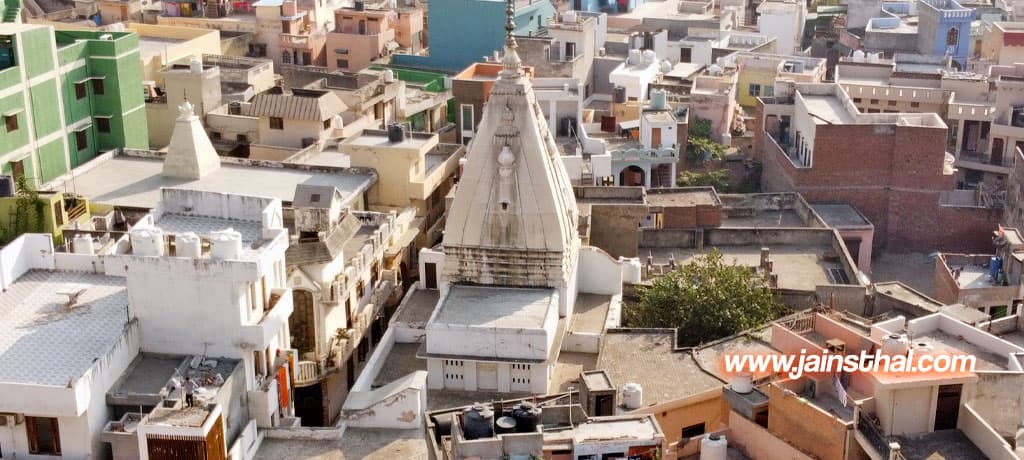
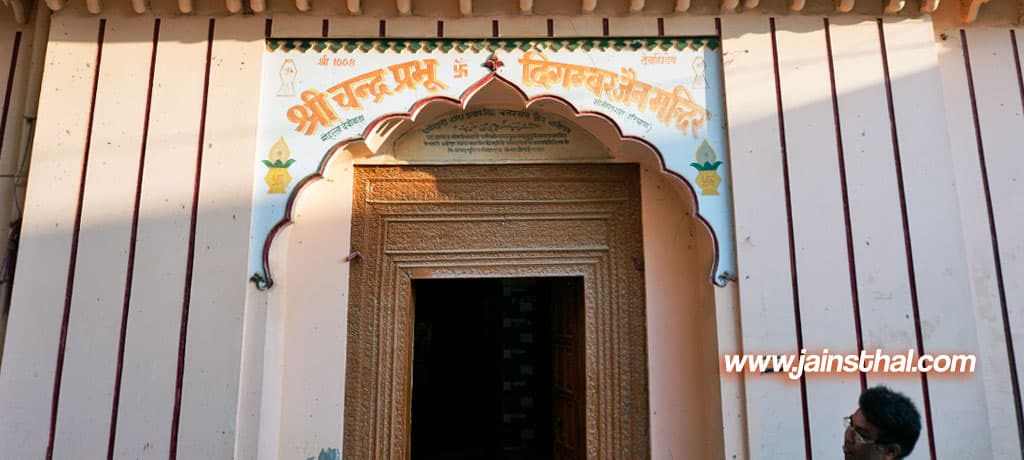
Shri 1008 Digambar Jain Mandir, located in Sonipat Mandi, was originally constructed 80 years ago as a Chaityalaya. Over time, due to its age and deteriorating condition, the Jain community decided to build a new temple in place of the prachin Chaityalaya. In 2017, the prachin Chaityalaya was demolished, and construction work for a new two-story Jain temple was started. The temple premises cover an area of 3200 square yards, which also includes a Jain dharamshala. Therefore, to accommodate all the idols for meanwhile the construction work in underway, a Vedi (altar) was constructed in the hall of the dharamshala and the pratimas are enshrined there. The Moolnayak Pratima (main deity’s idol) on the Vedi is of Shri 1008 Shantinath Bhagwan, which is extremely ancient. All together with the Moolnayak Pratima there are a total of seventeen Jain idols enshrined in the Vedi.
Initially, the hall had limited space, making it difficult for devotees to have darshan comfortably. Later, the hall's area was expanded, ensuring that devotees do not face any difficulties while having darshan. A scripture museum has also been established in the hall, where ancient Jain scriptures are safely preserved. In the old Chaityalaya, three Vedi were established. Therefore, in the new temple Garbh Grah (sanctum sanctorum), three Vedi are also being constructed. Among them, two Vedi are dedicated to Shri Shantinath Bhagwan and one Vedi is for Shri Parshvanath Bhagwan. In the new temple, three Khadgasana pratima of Shri Arhannath Bhagwan, Shri Shantinath Bhagwan, and Kunthunath Bhagwan will be enshrined. For devotees who are unable to climb stairs, provision for an elevator is also being made in the temple.
The height of the temple’s Shikhar (spire) was 81 feet, but now the new Shikhar being constructed will be 85 feet tall. Outside the new temple, a massive 41-foot tall Manastambh (pillar) has been erected. A meditation center has been built within the temple premises. For the use of pure water in the Abhishek (auspicious bath of the idol), a well has been constructed within the temple premises. Jain Saints have visited the area from time to time. The temple first hosted the Chaturmas (four-month monsoon retreat) of Aryika Kaushal Mata Ji in 1978. Following her, Acharya Shri Amrit Sagar Ji Maharaj has conducted Chaturmas at the temple twice. Acharya Shri 108 Guptisagar Ji Maharaj has visited the temple twice, and under his presence, the temple has undergone a Panchkalyanak as well. The first Panchkalyanak took place in 1996 and the other in 2002 under his guidance.
Dharamshala
In Sonipat Mandi, the Jain community comprises around thirty to forty families. Since the reconstruction of the temple began in the area, the financial condition of these families has significantly improved. All Jain families enthusiastically participate in the temple's activities. The Shri Digambar Jain Mandir Committee has arranged fifteen rooms for pilgrims coming to visit the temple from outside. Additionally, a building called the Tyagi Bhavan has been constructed by the Jain community for the accommodation of visiting Jain saints. From fifteen to twenty years, an Ayurvedic pharmacy has been running under the management of the temple committee. Medical treatment is provided at nominal charges in the pharmacy.
History
Sonipat is a district located in the state of Haryana, India. The name "Sonipat" is derived from the Sanskrit word meaning "the place of gold".
“It is believed that the city was founded around 1500 BCE by early Aryans.”
Sonipat has a rich historical significance and has witnessed three major battles, including significant conflicts between the Mughal Empire and Islamic sultans. The strategic location of Sonipat has made it an important historical site. It is a major city in the district and holds political and administrative significance. Many government and private offices and institutions of Haryana state are located here. Situated on the banks of the Yamuna River, the city has lush surroundings, although it has shifted approximately 15 kilometers eastward from its original location. Sonipat district is predominantly agrarian, with approximately 83% of its land used for farming. Wheat and rice are the primary crops cultivated, while other crops such as barley, pulses, sugarcane, millet, sesame, and vegetables are also grown. The Sonipat region is home to various cultural and historical sites, making it attractive to history enthusiasts. It boasts several temples, gurudwaras, and historical landmarks. The area's cultural heritage reflects its historical and archaeological significance, with many archaeological sites and protected areas attracting history lovers.
Know something about this temple?
Spot something missing or incorrect, or have extra info to share? Let us know and our team will take a look.
For the efficient management of Shri 1008 Digambar Jain Mandir, the Shri Digambar Jain Mandir Committee has been formed. The active members of the committee are as follows :