
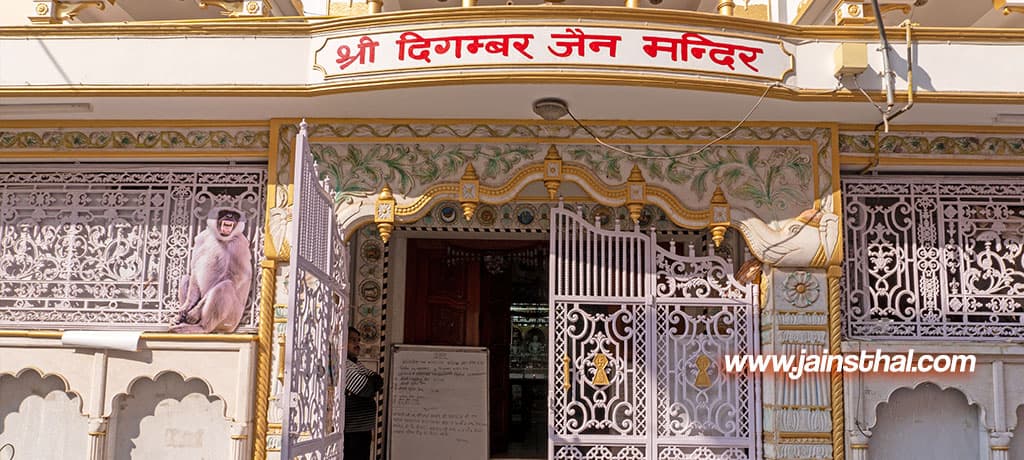
Shri Digambar Jain Temple, Rohtak Road, Karol Bagh
On a stormy night with heavy rainfall, the idol of Bhagwan Mahavir, which was firmly placed in the sanctum, mysteriously moved by itself and appeared on the temple steps without any human intervention.
In 2018, the temple was officially registered, and a management committee comprising 21 members was formed. The committee is responsible for overseeing temple operations and activities.
Introduction
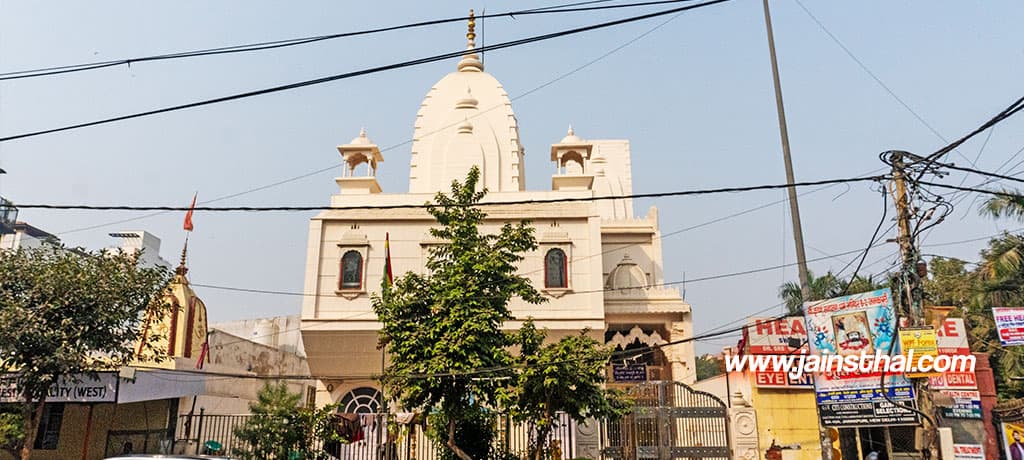
Shri Digambar Jain Temple, located in the central region of Delhi, Karol Bagh, is an important symbol of religious faith, grandeur, and divinity. The history of this temple dates back to 1953 when only four Jain families resided in the area. Due to the absence of a nearby Jain temple, they had to travel long distances for religious rituals and worship. To address this issue, they decided to establish a Chaityalaya in their home, enshrining an idol of Bhagwan Mahavir. They also vowed to construct a temple at a suitable location within the next two years. In 1955, a suitable plot was acquired, and a new Chaityalaya was built, reinstalling the idol of Bhagwan Mahavir. The construction of the Shikharbandh temple was completed in 1965, and during the Panch Kalyanak Mahotsav, several other idols were also consecrated. The idol of Bhagwan Parshvanath was enshrined as the principal deity in the main Garbh Grah (sanctum sanctorum). The temple underwent further renovation in 1998, enhancing its beauty and structure. Today, the temple stands as a living symbol of Jain religious and cultural heritage, preserving ancient traditions while attracting followers of the modern era.
Currently, the temple has three main altars. As visitors enter, they are welcomed into a spacious prayer hall, where these altars are enshrined within the sanctum. The central altar houses the principal deity, Bhagwan Parshvanath, made of white stone. Two additional white stone idols are also present, one of which is the original idol of Bhagwan Mahavir from the initial Chaityalaya. Furthermore, six small idols made of Ashtadhatu (a combination of eight metals) are placed here. To the right of Bhagwan Parshvanath’s altar, another idol of Bhagwan Parshvanath is enshrined in the altar as the moolnayak, while on the left, an altar for Bhagwan Shantinath is placed. In total, there are 21 idols in these altars, including those of Bhagwan Adinath (1), Bhagwan Padmaprabhu (1), Bhagwan Chandraprabhu (2), Bhagwan Sheetalnath (1), Bhagwan Vasupujya (2), Bhagwan Shantinath (2), Bhagwan Mallinath (1), Bhagwan Munisuvratanath (1), Bhagwan Neminath (1), Bhagwan Mahavir (2), Bhagwan Pushpadanta (1), and Bhagwan Parshvanath (4).
The temple is a hub of religious festivals and celebrations. The birth and Nirvana Kalyanak of Bhagwan Parshvanath are observed with immense devotion and enthusiasm. Karol Bagh is home to a cluster of ten Jain temples, and a grand procession is organized on Mahavir Jayanti, commencing from this temple and passing through other Jain temples in the vicinity, spreading religious fervor. The temple also hosts frequent visits from Jain Saints. The first Chaturmas here was observed by Acharya Shri 108 Vidyanand Maharaj. Additionally, Acharya Shri Saubhagyasagar Ji Maharaj received the title of Acharya on November 6, 2014, at this temple. Chaturmas by Aryika 105 Dakshamati Mataji and Aryika 105 Chandramati Mataji were also conducted here, with Acharya Ativeer Sagar Ji’s Chaturmas being the most notable and grandest.
Atishay Katha
One of the most famous miraculous stories associated with Shri Digambar Jain Temple continues to strengthen the faith and devotion of its followers. This story dates back to the establishment of the Chaityalaya in 1953 when the Jain community enshrined an idol of Bhagwan Mahavir and vowed to build a temple within two years. It is said that exactly after two years, an astonishing incident took place.
“On a stormy night with heavy rainfall, the idol of Bhagwan Mahavir, which was firmly placed in the sanctum, mysteriously moved by itself and appeared on the temple steps without any human intervention.”
Witnessing this divine event, the community was awestruck and considered it a sacred sign. They humbly sought forgiveness from Bhagwan Mahavir and reinstalled the idol with great reverence. The very next day suitable land was acquired marking a significant milestone in the temple’s construction. Another recent miraculous event involved a devotee who had difficulty walking. After regularly performing Abhishek (ceremonial bathing of the idol) at the temple, he not only regained his ability to walk but also began performing the ritual at the principal altar himself. Such divine occurrences further elevate the temple’s sanctity, reinforcing it as a place of spiritual blessings and faith in Bhagwan Jinendra’s grace.
Jain Samaj
Shri Digambar Jain Temple, New Rohtak Road, Karol Bagh, holds immense significance among the Jain community. Currently, around 110 Jain families reside in the vicinity, regularly participating in worship and religious events at the temple. The temple exemplifies the unity and cultural richness of the Jain society. Approximately 250-300 devotees visit the temple daily, including both local residents and visitors from distant places. Nearby, the Jain community operates two hostels named "JITO" and "JIO," where children reside and actively engage in temple activities, fostering religious and cultural values in future generations.
For the accommodation of Jain Saints and ascetics, the temple has a modern "Tyagi Bhavan," designed to meet their requirements. All rooms in the Tyagi Bhavan are air-conditioned, ensuring comfort during extreme weather conditions. Additionally, a fully equipped kitchen is available, making food arrangements convenient for the monks. The temple committee also emphasizes the spiritual and educational growth of Jain youth and children. Every year, a week-long educational camp is organized, imparting religious teachings, Jain philosophy, and ethical values. These camps not only provide valuable knowledge but also serve as an important platform to deeply acquaint children with Jainism.
History
The National Capital Territory of Delhi is the capital of India and a Union Territory. Being the capital, it serves as the headquarters for the three branches of the Indian government—Executive, Legislature, and Judiciary. Situated on the banks of the Yamuna River, Delhi has a glorious historical significance, with references in ancient texts. It is one of India’s oldest cities, with archaeological evidence linking it to the Indus Valley Civilization. The rise of the Delhi Sultanate established the city as a major political, cultural, and commercial hub, with numerous ancient and medieval architectural marvels still standing today.
Delhi finds its earliest mention in the epic Mahabharata, where it is referred to as Indraprastha, the capital of the Pandavas. The city is not only the nation’s capital but also a prominent tourist destination. Being the seat of the Indian government, it houses iconic modern structures like Rashtrapati Bhavan, Parliament House, and Central Secretariat. It also holds immense historical significance, boasting archaeological sites like Purana Qila, Safdarjung’s Tomb, Jantar Mantar, Qutub Minar, and the Iron Pillar. The city is home to renowned religious landmarks such as Birla Temple, Katyayani Shaktipeeth, Lal Jain Temple, Bangla Sahib Gurudwara, Lotus Temple, Akshardham Temple, and Jama Masjid. The war memorial India Gate is another prominent attraction, honoring the nation's martyrs. Today, Delhi has emerged as India’s commercial capital, serving as the country’s primary trade and business center.
Know something about this temple?
Spot something missing or incorrect, or have extra info to share? Let us know and our team will take a look.
In 2018, the temple was officially registered, and a management committee comprising 21 members was formed. The committee is responsible for overseeing temple operations and activities.