
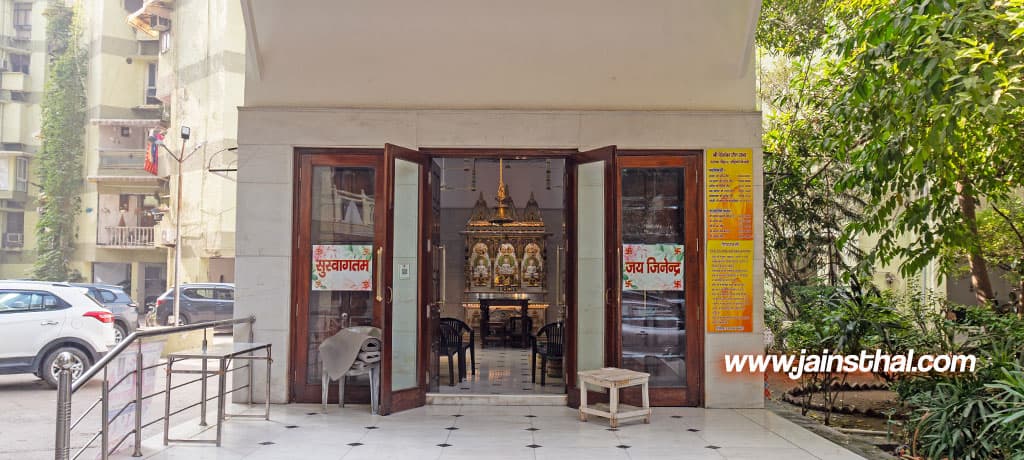
Vallabh Vihar Jain Mandir, Rohini
The earliest reference to Delhi is found in the Mahabharata, where it is mentioned as Indraprastha, the legendary capital of the Pandavas.
For the efficient management and smooth operation of the temple, Shri Digambar Jain Sabha (Registered), Vallabh Vihar, Rohini Sector-13 Temple Committee has been established. The key office bearers of the committee are:
Introduction
Shri 1008 Chandra Prabhu Digambar Jain Temple is situated in Vallabh Vihar Apartments, located in Rohini Sector-13, New Delhi. This residential complex is a prominent religious hub for all three major sects of Jainism - Digambar, Shwetambar, and Sthanakwasi - making it a significant center for Jain devotees. Within this area, one can find a Digambar Jain Temple, a Shwetambar Jain Temple, and a Jain Sthanak, enhancing its spiritual importance. In the year 2001, the present-day Digambar Jain Temple was initially established in a temporary structure with a tin shed, where the idol of Lord Chandra Prabhu was enshrined. The idol was consecrated under the sacred guidance of Acharya Shri 108 Shantisagar Ji Maharaj during a grand Panch Kalyanak Mahotsav held in Sonipat. In 2010, with the unanimous agreement of the Jain community, the temporary tin-shed shrine was transformed into a magnificent Shikharbandh Jain temple. The construction of this temple was successfully completed under the guidance of Upadhyay Shri 108 Guptisagar Ji Maharaj, making it an even more divine and significant place of worship.
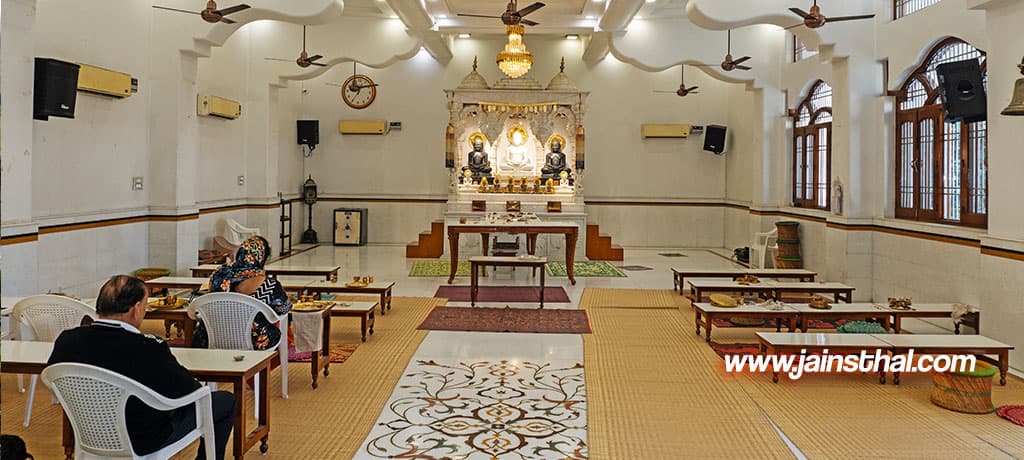
The temple primarily features a single Vedi (altar), where the stunning and spiritually powerful white marble idol of Shri 1008 Chandra Prabhu Bhagwan is enshrined as the Moolnayak (the principal deity). This idol is renowned for its divine aura, drawing devotees not only from the nearby areas but also from different parts of Delhi. Many visitors experience an extraordinary sense of peace and spiritual energy upon having darshan of the revered idol. Alongside the Moolnayak idol, the temple also houses the beautifully crafted white marble idols of Shri Munisuvratnath Bhagwan and Shri Neminath Bhagwan. Additionally, the temple enshrines Ashtadhatu idols (idols made from a combination of eight metals) of Shri Adinath Bhagwan, Shri Parshvanath Bhagwan, and Shri Mahavir Bhagwan, further enhancing the temple’s spiritual significance.
From an architectural and vastu perspective, this temple is considered highly auspicious. It is believed that the temple’s Vedi is perfectly aligned towards the east, ensuring a continuous flow of positive energy throughout the premises. Due to its spiritual prominence, whenever Jain saints visit the Rohini region, they make it a point to visit this sacred temple for darshan and prayer. Since Vallabh Vihar is home to followers of all three sects of Jainism - Digambar, Shwetambar, and Sthanakwasi - the residents share a deep sense of unity, harmony, and mutual respect. Daily rituals such as puja, abhishek, prakshal, and shantidhara are performed by Jain devotees, adding to the temple’s spiritual energy.
Jain Samaj
Shri 1008 Chandra Prabhu Digambar Jain Temple is a well-established religious center in Vallabh Vihar Society, Rohini Sector-13, Delhi. To ensure the smooth administration of the temple, a registered temple committee has been formed, which efficiently manages all temple-related affairs.
For devotees visiting from outside the region, necessary arrangements can be made upon prior contact with the temple committee. However, accommodation facilities are not available within the temple premises.
History
The National Capital Territory (NCT) of Delhi is not only the capital of India but also a Union Territory. Being the nation’s capital, it serves as the administrative headquarters of all three branches of the Indian government—the Executive, the Legislature, and the Judiciary. Situated on the banks of the Yamuna River, Delhi has a rich and glorious history, deeply rooted in ancient Indian scriptures and mythology. It is one of India's oldest cities, with historical evidence tracing its origins back to the Indus Valley Civilization. Excavations in and around Haryana provide further proof of Delhi's ancient heritage. With the rise of the Delhi Sultanate, the city became a major political, cultural, and commercial hub. Today, numerous historical and medieval structures can still be seen throughout Delhi, adding to its historical grandeur.
“The earliest reference to Delhi is found in the Mahabharata, where it is mentioned as Indraprastha, the legendary capital of the Pandavas.”
Delhi is not only the political capital of India but also a major tourist destination. As the seat of power, it houses numerous government offices, including Rashtrapati Bhavan (Presidential Palace), Parliament House, and Central Secretariat. Additionally, Delhi's rich history is reflected in its many archeological sites, such as Purana Qila, Safdarjung’s Tomb, Jantar Mantar, Qutub Minar, and the Iron Pillar. Delhi is also home to several renowned religious sites, including Birla Mandir, Katyayani Shaktipeeth, Lal Jain Mandir, Bangla Sahib Gurudwara, Lotus Temple, Akshardham Temple, and Jama Masjid. Moreover, India Gate, a memorial dedicated to the nation's martyrs, stands as a prominent landmark on Rajpath. Today, Delhi has evolved into India’s primary commercial hub, serving as a vital center for trade, business, and governance.
Know something about this temple?
Spot something missing or incorrect, or have extra info to share? Let us know and our team will take a look.
For the efficient management and smooth operation of the temple, Shri Digambar Jain Sabha (Registered), Vallabh Vihar, Rohini Sector-13 Temple Committee has been established. The key office bearers of the committee are: