
Swasti Dham Atishay Kshetra Jahazpur
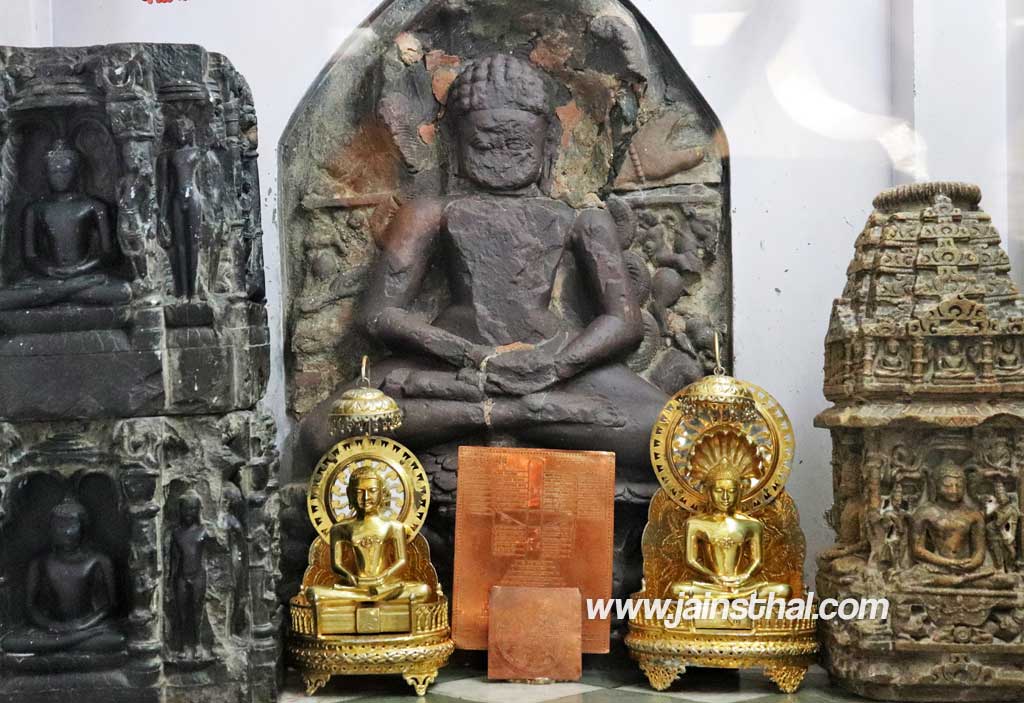
Several Jain idols had appeared in the area previously.
The management of the Shri 1008 Munisuvratnath Digambar Jain Atishay Kshetra (Swasti Dham) Mandir is carried out by the committee. The members of the committee are :
Introduction
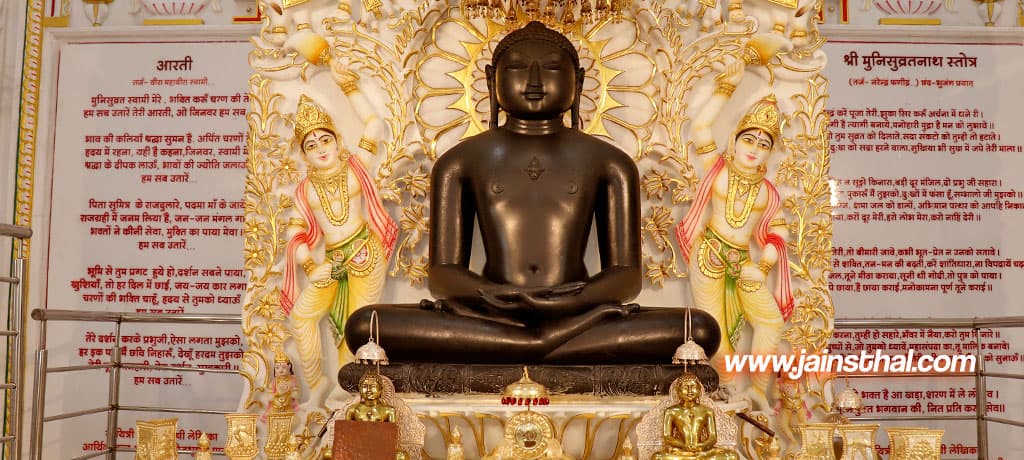
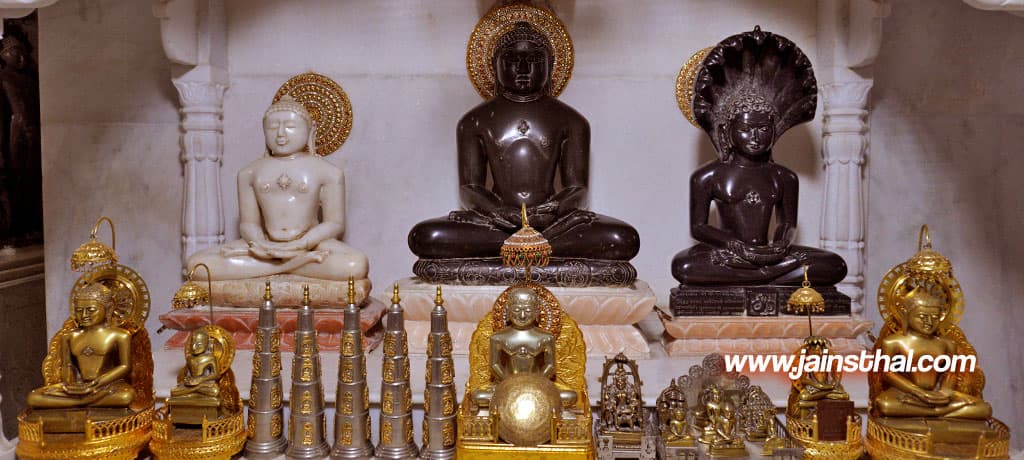
Swasti Dham Atishay Kshetra is located on Rajasthan National Highway 39 between the towns of Jahazpur and Jalamapur. Jahazpur city is 100 kilometers away from Bhilwara Railway Station and 180 kilometers from Jaipur. In the Swastidham Atishay Kshetra, a grand and magnificent temple is erected in the shape of a ship dedicated to Shri 1008 Munisuvratnath Bhagwan. Outside the temple's entrance stands a massive Manastambh . Upon entering the temple, we encounter a beautiful and spacious hall constructed with white marble stones from all sides. The hall contains three Sahastrakut Vedi (altar), each adorned with 1008 idols. On the second floor of the temple, there are three more Vedi, with the Mool Vedi (main altar) featuring an attractive and ancient idol of Shri 1008 Munisuvratnath Bhagwan. Gold work has been done on the Vedi, enhancing its beauty. To the right of the main Vedi, there is a Vedi with the Mool Pratima (main deity’s idol) of Shri 1008 Adinath Bhagwan. To the left of the Mool Vedi, there is a Vedi with the Mool Pratima of Shri 1008 Mahavir Bhagwan. On the topmost floor of the temple, 24 Jain Tirthankar, known as Chaubisi Vedi is established. From January 21, 2020, to February 7, 2020, Panchkalyanak (consecration ceremony) in the temple was conducted in the presence of Acharya Shri 108 Gyan Sagar Ji Maharaj and Aryika Ratna 105 Shri Swasti Bhushan Mata Ji at the temple.
Atishay Katha
On the auspicious occasion of Mahavir Jayanti in 2013, located 4 kilometers away from the temple, a idol of Shri 1008 Munisuvratnath Bhagwan Ji emerged from the home of a member of the Muslim community in the area.
“Several Jain idols had appeared in the area previously.”
This time, on the holy day of Shri 1008 Mahavir Bhagwan Ji Jayanti, the idol of Shri 1008 Munisuvratnath Ji manifested. Upon seeing the idol, everyone was mesmerized. The idol appeared as if it were made of sapphire, captivating the onlookers. The government officials presumed the idol to be worth millions and decided to take it under government control. They attempted to extract the idol using a crane, but due to narrow lanes, it was not feasible. The Jain community members joined forces and carried the idol on a cart, placing it temporarily in the temple storeroom. Upon returning, the officials assured the locals that they would take the idol, and for this, they called laborers. Approximately 40 to 45 laborers joined but were unable to move the idol. Therefore they returned empty-handed. After a wait of 1.5 months, the government decided to hand over the idol to the Jain community. Later, inspired by Aryika Ratna 105 Shri Swasti Bhushan Mata Ji, the decision was made to construct the temple. Slowly, the construction of the temple was completed, and the time came for the establishment of the idol. However, when Mata Ji was about to arrive, there was a delay. As time passed, the Jain community members decided to promptly place the idol in the temple. Taking the idol with them, they headed towards the temple, but as soon as they reached the temple's entrance, the weight of the idol increased. Everyone was astonished. It seemed as though they should wait for Mata Ji's arrival. Indeed, when Mata Ji Shri Swasti Bhushan Ji arrived, the weight of the idol lightened again. The idol was then enshrined in the temple. So far, the idol has changed its color four times. Once during an aarti ceremony in the temple, light emanated from the idol's eyes suddenly. The presence of the idol's navel, sometimes inward and sometimes outward, was observed by all present. Even today, many such miraculous occurrences continue to happen in the temple, attracting devotees from far and wide to behold this enchanting idol.
Dharamshala
Adjacent to the temple, there is a dharamshala with 108 rooms equipped with all kinds of facilities. The Dharamshala has 108 rooms available, both AC and non-AC. Accommodation for up to 300 pilgrims at a time can be arranged in the Dharamshala. There is also provision for hot water through geysers. The dharamshala also has a dining hall, named Tushti Pushti Bhojanshala. Pure vegetarian meals are prepared daily in the dining hall. Parking facilities are available for pilgrims coming from afar. Separate rooms are provided for drivers of vehicles.
History
Bhilwara is also known as the Textile City. Bhilwara is famous across India for its textile production. It is bordered by the districts of Bundi and Tonk to the east, Chittorgarh to the west, Ajmer to the north, and Rajsamand to the south. Bhilwara covers an area of approximately 10,455 square kilometers. It is believed that Bhilwara was inhabited by the Bhil community, hence the name Bhilwara. According to one theory, the Mewar textile industry was established here, where coins called Bhiladi were minted, leading to the name Bhilwara. Bhilwara exports marble to the whole world after extracting it from mines. Bhilwara is dotted with rivers, waterfalls, and dams to explore. The confluence of the Banas, Bedach, and Menal rivers can be seen in Bhilwara. The construction of the fort in Jahazpur was originally carried out by the great Mauryan emperor Ashoka's grandson Samprati, who was a follower of Jainism. There are two famous Jain temples here.
Know something about this temple?
Spot something missing or incorrect, or have extra info to share? Let us know and our team will take a look.
The management of the Shri 1008 Munisuvratnath Digambar Jain Atishay Kshetra (Swasti Dham) Mandir is carried out by the committee. The members of the committee are :