
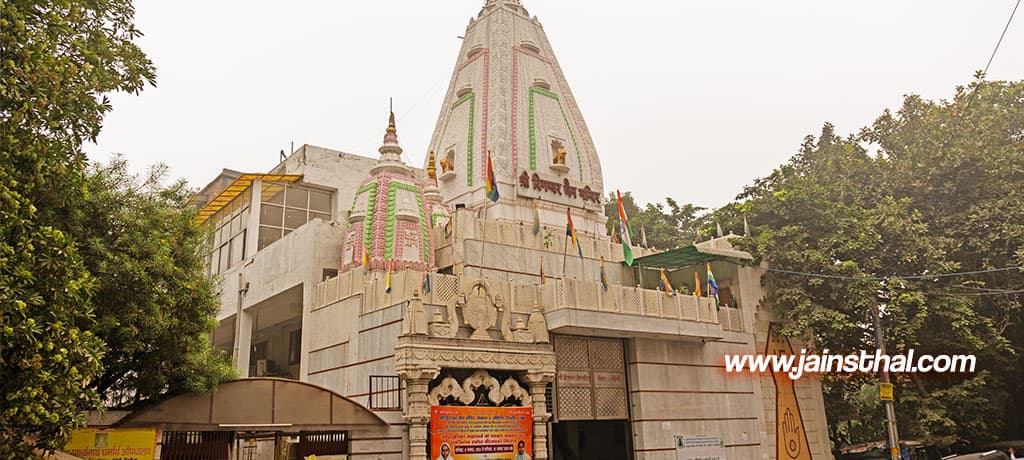
Rohini Sec 3 Jain Mandir
The idol of Bhagwan Parsvanath is believed to possess immense divine power, with devotees often returning for darshan.
To ensure the smooth operation of the temple, the Shri Digambar Jain Society (Regd.), Sector 3 Rohini, has been established. The active members of the committee are:
Introduction
The Shri 1008 Parsvanath Digambar Jain Temple is situated in Rohini Sector-3, Block D-15, Delhi, the capital city of India. The nearest metro station is Rohini West, just 500 yards from the temple. Although there are several Jain temples in the Rohini area, this temple holds the distinction of being the first Jain temple built by the local Rohini Jain community. Before its construction, in 1996, Shri Makkhan Lal Jain, a local resident, established a Chaityalaya and enshrined an idol of Shri Parsvanath Bhagwan, which was brought from the Pritampura temple. As the Jain community in the area expanded, the Chaityalaya was transformed into a Shikharbandh Jinalaya (spire-topped temple). With the inspiration of Acharya Shri 108 Saurabh Sagar Ji Maharaj and the support of Shri Makkhan Lal Jain and the entire Jain community, the temple was constructed. The first Panchkalyanak Pratishtha Mahotsav (consecration ceremony) was celebrated in 2005 under the guidance and presence of Acharya Shri 108 Saurabh Sagar Ji Maharaj. Today, upon entering the temple, the first sight to the left is of Shri Kshetrapal Baba Ji. Further ahead, you will find the Samvasharan Vedi (altar), where four idols of Jinendra Bhagwan are positioned, each facing a different direction. The Garbh Grah (sanctum sanctorum) of the temple is designed as a spacious hall, within which five Vedis (altars) are established. Three of these altars are dedicated to Bhagwan Jinendra, one is devoted to Mata Padmavati, and one is for Jinvani Mata Ji. The central altar enshrines the Moolnayak idol (principal deity) of Shri 1008 Parsvanath Bhagwan, accompanied by four other idols.
“The idol of Bhagwan Parsvanath is believed to possess immense divine power, with devotees often returning for darshan.”
A small silver idol of Shri Parsvanath Bhagwan is also placed on this altar. Each of the three altars dedicated to the Jinendra Bhagwans houses five idols. To the left of the main altar is another Vedi, where the original idol of Shri Parsvanath Bhagwan, which was previously enshrined in the Chaityalaya, is placed. On the right side of the main altar, you will find a statue of Shri Suparshvanath Bhagwan, crafted from white stone. The Garbh Grah of the temple is beautifully decorated with glass paintings that depict various Jain stories, adding to its visual appeal. The temple frequently hosts visiting Jain saints. The first Chaturmas (a religious retreat) at the temple was conducted by Shri 108 Pragya Sagar Ji Maharaj in 2006, and several such events have taken place since then. Currently, the Chaturmas is being observed by Aryika Ratan 105 Shri Saraswati Bhushan Mata Ji. Jain devotees regularly visit the temple to offer prayers and perform rituals. The area is known for its strong sense of unity between the Digambar and Shwetambar Jain communities, both of which actively participate in and support each other's religious activities.
Jain Samaj
The Shri Digambar Jain Society (Regd.) in Sector 3, Rohini, was established to ensure the smooth operation of this temple. The temple committee is actively engaged in social welfare initiatives. Several Jain families reside in the vicinity of the temple and regularly visit to offer prayers and perform rituals. The temple has a prayer hall on its lower floor, which is used for religious events. Additionally, the temple committee operates an allopathic dispensary, offering consultations for a nominal charge of Rs. 20, with medicines provided free of cost. The committee also organizes religious camps to raise awareness of Jainism within the community.
History
The National Capital Region (NCR) of Delhi is both the capital of India and a union territory. As the capital, Delhi houses the headquarters of all three branches of the Indian government: the executive, legislature, and judiciary. Situated along the banks of the Yamuna River, Delhi boasts a rich historical legacy, with significant mentions in ancient scriptures. One of the oldest cities in India, its history dates back to the Indus Valley Civilization, as evidenced by excavations in Haryana.
Delhi rose to prominence as a political, cultural, and commercial center during the era of the Delhi Sultanate. The city is home to numerous ancient and medieval structures, many of which still stand as historical landmarks.The earliest mention of Delhi is found in the Mahabharata, where it is referred to as the ancient Indraprastha, the capital of the Pandavas. Today, Delhi is not only the nation’s capital but also a major tourist destination. The city is home to key landmarks such as the President’s House, Parliament House, Central Secretariat, and other examples of modern architecture. In addition, historical sites like the Red Fort, Safdarjung Tomb, Jantar Mantar, Qutub Minar, and the Iron Pillar further enrich its cultural heritage.
Delhi also features important religious sites representing various faiths, including the Birla Temple, Katyayani Shaktipeeth, Red Jain Temple, Bangla Sahib Gurudwara, Bahai Temple, Akshardham Temple, Jama Masjid, and the India Gate, a memorial honoring the nation’s martyrs. Today, Delhi is a thriving business hub and a key center of commerce in India.
Know something about this temple?
Spot something missing or incorrect, or have extra info to share? Let us know and our team will take a look.
To ensure the smooth operation of the temple, the Shri Digambar Jain Society (Regd.), Sector 3 Rohini, has been established. The active members of the committee are: