
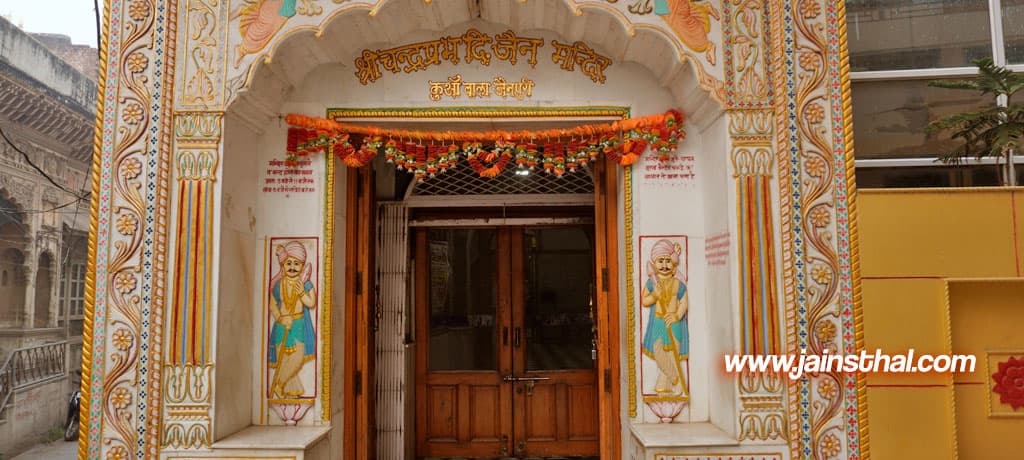
Rewari Chandraprabhu Jain Mandir
Nanak Chand Jain, a member of the Jain community, shared that in old times, the voice of sweet music was heard by the temple's Vyasa (narrator of sacred texts) during certain occasions.
A temple committee has been formed for the smooth functioning of the temple. The members working in the committee are as follows :
Introduction
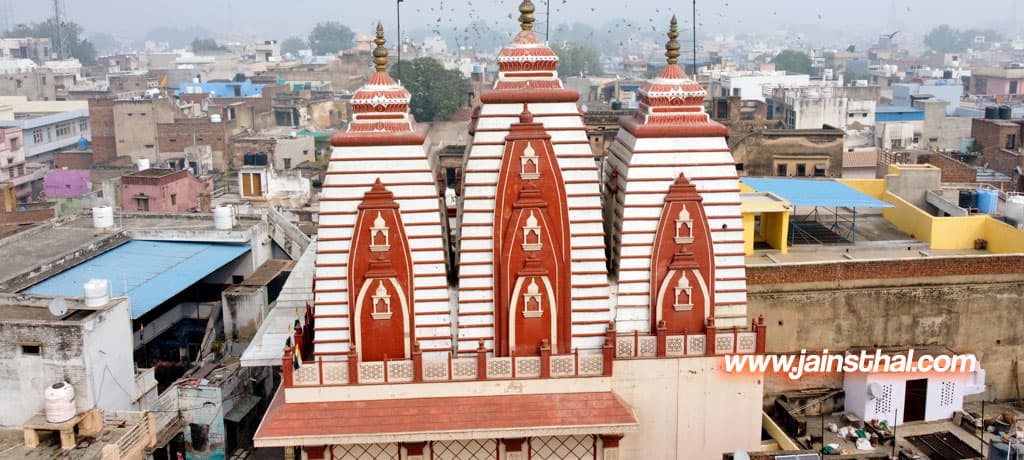
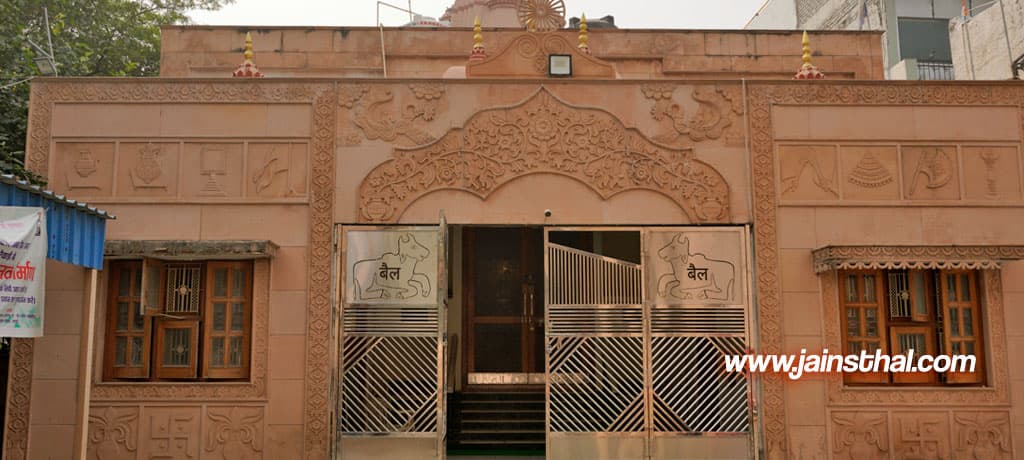
Shri 1008 Chandraprabhu Digambar Jain Mandir, also known as the Kua Wala Mandir in Rewari city, is approximately 200 years old. The foundation of this temple was laid on Phalgun Sudi 5, Vikram Samvat 1883 (1827 AD). The temple houses extremely magnificent and captivating idols. The Moolnayak Pratima (main deity’s idol) of this temple is of Shri 1008 Chandraprabhu Bhagwan. In front of the main entrance of the temple, there is an ancient well approximately 65-70 feet deep. This is why the temple is also known as the Digambar Jain Mandir Kua Wala. Initially, this temple was limited to the Garbh Grah (sanctum sanctorum). Over time, with development, the temple gradually expanded and today it has become immense.
Ancient artwork in gold adorns the walls, Vedi, and domes of the 1008 Shri Chandraprabhu Digambar Jain Mandir, showcasing the excellent craftsmanship and artistry of the temple and captivating the minds of visitors and devotees. Within the temple courtyard, there is the Acharya Shantisagar Hall, which provides excellent accommodation for gatherings and the Chaturmas (four-month monsoon retreat) of Saints. Within the temple courtyard, there is also the Shri Digambar Jain Dharmarth Ayurvedic Pharmacy, where patients are treated using Ayurvedic methods.
There are a total of five Vedi (altar) established in the temple. In the Mool Vedi (main altar), along with the idol of Shri 1008 Chandraprabhu Bhagwan Ji, dating back to Vikram Samvat 1921, year 1864, other Jain idols are also enshrined. In the second Vedi of the temple, the idol of Shri 1008 Suparshvanath Bhagwan Ji from the 15th century is enshrined. The third Vedi of the temple is dedicated to Bhagwan Bahubali. The fourth Vedi of the temple also belongs to Shri 1008 Chandraprabhu Bhagwan Ji. In the fifth Vedi of the temple, the Moolnayak Pratima (main deity’s idol) is of Shri 1008 Adinath Bhagwan Ji. All Vedi feature other idols made of various stones and metals. Which are such as :
Idol of Shri 1008 Chandraprabhu Bhagwan, Vikram Samvat - 1921, year - 1864, month - Jyeshtha Shukla - 5 (Moolnayak Pratima).
In the temple, on the first floor, on the 14th day of the Shukla Paksh of Paush month, Veer Nirvan Samvat - 2526 (January 21, 2000), in the presence of Acharya 108 Shri Vidyanand Ji Maharaj's foremost disciple 108 Shri Shrutasagar Ji Maharaj, a magnificent 7-foot tall Bhagwan Bahubali Ji's standing idol was enshrined on a Vedi, attracting devotees towards itself. (Moolnayak Pratima) Shri Bahubali idol, Height - Seven feet (on a pedestal), Veer Samvat - 2526, Year - 2000, Month - Paush Shukla - 14
Once, there was a disagreement between some members of the Jain community and Shri Rajendra Kirti Bhattarak Ji (popularly known as Jati Ji). Due to this disagreement, some members of the community decided to construct the 1008 Shri Chandraprabhu Digambar Jain Mandir, known as the Kuan Wala Mandir, with the support of the community. Jati Ji was a highly revered and miraculous figure. He warned that anyone who would enshrine idols in the temple without his permission and advice at an inappropriate time would certainly meet their demise, and similarly, anyone who would engage in the study of scriptures and religious discussions sitting on the seat of authority would also meet their end. This statement by Jati Ji turned out to be true. Both the person who enshrined the idols and the one who improperly studied the scriptures were obstinate in nature, they did not heed Jati Ji's words, and both met their demise.
Atishay Katha
Mr.
“Nanak Chand Jain, a member of the Jain community, shared that in old times, the voice of sweet music was heard by the temple's Vyasa (narrator of sacred texts) during certain occasions.”
To verify the authenticity of this, some individuals concealed themselves inside the temple. They heard a voice instructing that from that day onward, such behavior of hiding inside the temple would not be tolerated. This incident indicates that during the night, the divine beings indeed engage in musical worship, and they do not prefer obstacles in their devotion. Once, in the year 2016, at 4:00 in the morning when the temple was opened, the Vyasa of the temple, saw Devs adorned in yellow robes and adorned with glittering jewels, was performing the Abhishek (auspicious bath of the idol) of the idol of Shri 1008 Chandraprabhu Bhagwan. As soon as Dev saw the Vyasa, they immediately became invisible, leaving the Vyasa astonished and amazed at what he had witnessed.
Dharamshala
Dharma nagari Rewari has been blessed by the grace of Bhagwan Shri Mahavir Swami and Digambar Saints, along with the special blessings of the elders. As a result, there are six Jain temples, seven Jain schools, and approximately ten other community-oriented institutions operating here. The society in Rewari comprises approximately 200 Jain families. The management of Jain temples is efficiently handled by the Jain community. Provision is made for pilgrims coming from distant areas to halt for sightseeing at Jain temples. Upon prior arrangement, food arrangements are also made available. Accommodation arrangements are made in the Tyagi Bhavan for the arrival of Jain Saints in the area.
History
Rewari is located in the Haryana state of India. It is situated around the Indian National Highway (NH-71B) and serves as the headquarters of Rewari district. The history of the Rewari region is very ancient, and there are several ancient monuments and historical sites around it. Rewari, in itself, is a multi-dimensional place known for its talented individuals, great artists, poets, writers, warriors, religious sites, educational institutions, and natural beauty, making it a place in southern Haryana where one feels tranquility and sanctity upon arrival.
During ancient Mahabharata times, there was a king named Revat, whose daughter's name was Revati. The city 'Rewa Wadi' was founded in her honor. Rewari is famous for its cuisine, particularly its Revdiyan (a sweet). The first cow shelter (gaushala) of India was established here in 1878, which was built by King Rao Yudhishthira Yadav. The Rewari region has also played a significant role in economic development and is a modern market center that provides nearby villages and towns with essential goods and services. Additionally, there are several natural beauty spots near the Rewari region that attract tourists. Overall, the Rewari region is an important and developing area, crucial from cultural, economic, and environmental perspectives.
Know something about this temple?
Spot something missing or incorrect, or have extra info to share? Let us know and our team will take a look.
A temple committee has been formed for the smooth functioning of the temple. The members working in the committee are as follows :