
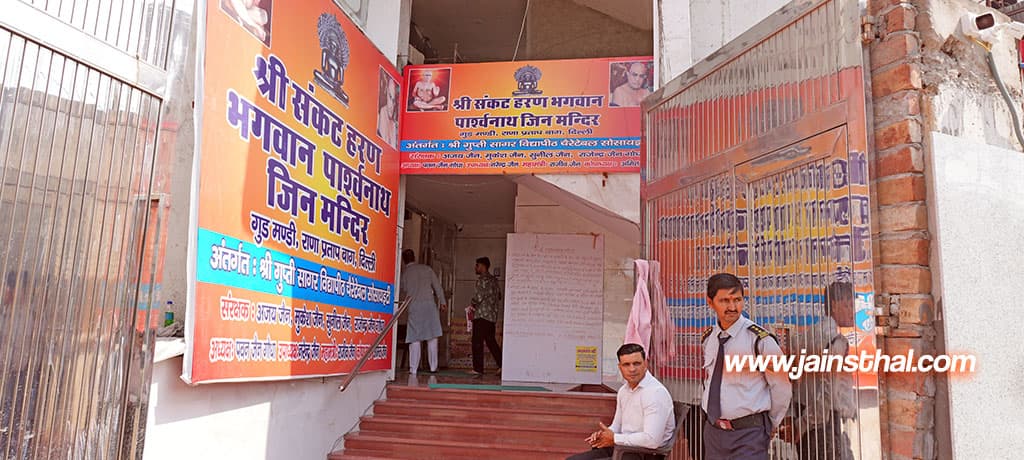
Shri 1008 Sankat Haran Parshvanath Jin Mandir
The idol is so lifelike that it appears as though Acharya Shri is seated in eternal form, blessing all who come.
For the smooth functioning of the temple, Shri 1008 Sankat Haran Parshvanath Jin Mandir Committee has been formed. The members working in the committee are:
Introduction
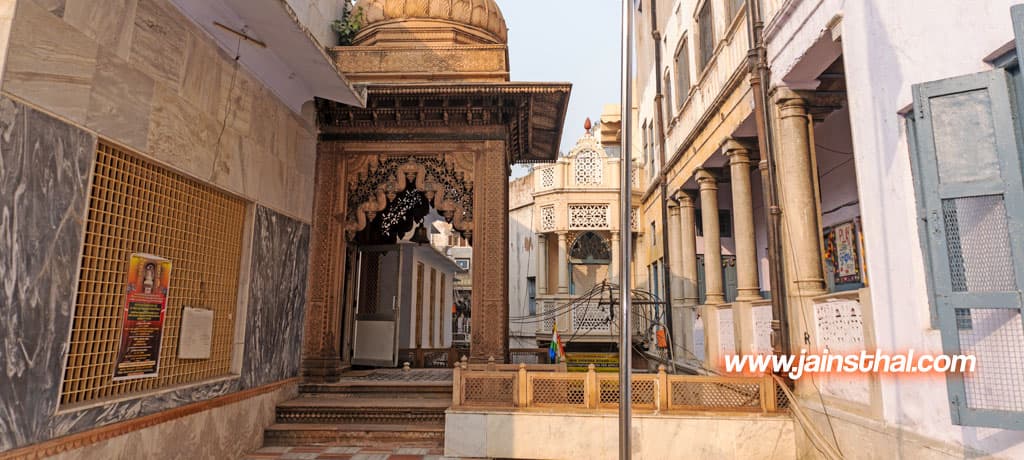
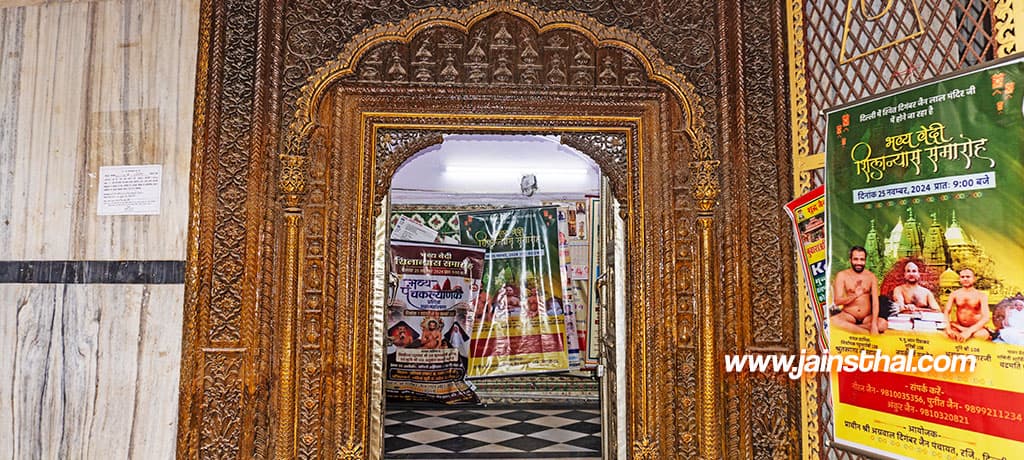
The Shri 1008 Sankat Haran Parshvanath Jin Mandir is situated in Rana Pratap Bagh, Ashok Vihar, in the heart of India’s capital, Delhi. In 2019, inspired by Upadhyaya Shri 108 Guptisagar Ji Maharaj, a small prayer hall (Chaityalaya) was initially built here. Following his guidance, the Jain community decided to transform this Chaityalaya into a grand, spire-topped (shikhara bandh) Jin Mandir, covering a vast area of 1400 square yards. The temple's construction was carried out progressively through the dedicated efforts of the entire Jain community, with Shri Pawan Jain Godha Ji playing a pivotal role. His relentless hard work and invaluable contributions made the completion of the temple possible. After its construction, the temple hosted the Panch Kalyanak Pratishtha Mahotsav (consecration ceremony) from April 19 to April 25, 2024. Upon entering the temple, visitors are welcomed by the magnificent sight of a spacious Garbh Grah (sanctum sanctorum) made of pristine white marble, featuring intricate and exquisite carvings by Jaipur artisans on Makrana marble. In the Garbh Grah (sanctum), there are twenty-nine Vedis (altars) in total, with five main altars, each holding three idols. The remaining twenty-four Vedis are dedicated to the twenty-four Tirthankaras of Jainism, with one idol of each Tirthankar enshrined on each Vedi. The central Vedi of the temple is devoted to Moolnayak Pratima (main idol) of Shri 1008 Parshvanath Bhagwan, featuring three idols made of black stone. Additionally, smaller idols crafted from Ashtadhatu (eight metals) are also enshrined in the Vedi. To the right and left of the main Vedi, two additional principal Vedis are positioned, each holding a Padmasana idol of a Tirthankar. On the right side of the Vedi, the Vedis of Shri 1008 Mahavir Bhagwan and Shri 1008 Munisuvratanath Bhagwan are enshrined, while on the left, the Vedis of Shri 1008 Chandraprabhu Bhagwan and Shri 1008 Adinath Bhagwan are placed. Additionally, twenty-four Vedis house idols of the twenty-four Tirthankaras, each crafted from Ashtadhatu (eight metals) and weighing 450 kg. All these Vedis are visible together as one enters the Garbh Grah. Beneath the Garbh Grah, in the basement a spacious hall covering 1300 square meters has been constructed, serving as a venue for religious activities and rituals. This hall is equipped with seating for 1,000 people. Within the hall stands an Ashtadhatu idol of Param Pujya Acharya Shri 108 Vidyasagar Ji Maharaj, weighing 3200 kg.
“The idol is so lifelike that it appears as though Acharya Shri is seated in eternal form, blessing all who come.”
The mere sight of this idol offers an extraordinary spiritual experience to devotees, establishing this temple as one of the most prominent in Delhi. Since its completion, the temple has seen daily visits from over five hundred devotees. The temple’s construction has inspired the youth, and they too now come regularly to offer their prayers. The strong devotion of the community is evident, as even during the global COVID-19 pandemic, there was a Chaityalaya, still the Jain community daily performed Shantidhara. Jain saints and Maharaj also visit periodically, with notable visits from Upadhyaya Shri 108 Guptisagar Ji Maharaj, Shri 108 Sunil Sagar Ji Maharaj, Acharya Shri 108 Pragya Sagar Ji Maharaj, and Aryika 105 Sarvmatti Mata Ji. The temple also ensures that all necessary facilities are available for pilgrims visiting from other places.
Jain Samaj
Over five hundred members of the Jain community are associated with the Shri 1008 Sankat Haran Parshvanath Jin Mandir, located in Rana Pratap Bagh, Delhi. To manage the temple’s operations, a dedicated committee, the Shri 1008 Sankat Haran Parshvanath Jin Mandir Committee, has been established. This committee also runs an Ayurvedic dispensary, offering medicines free of charge with a nominal token fee of twenty rupees. In support of community welfare, the Jain society generously contributes to the hospital’s fund. Shri Pawan Jain Godha Ji, the temple president, organizes Jain pilgrimage tours to raise awareness of Jain darshan. Additionally, the committee arranges various religious programs to further promote the values of Jainism.
For pilgrims visiting from other locations, the Jain Dharamshala adjacent to the temple offers essential accommodation facilities. Additionally, the committee provides food services. Since the establishment of the Chaityalaya, a free meal service has been running, catering to the needy. During the COVID-19 pandemic, the committee distributed food to over five lakh people across various hospitals, and to date, more than seven lakh people have received meals. Every day, from 12 PM to 1 PM, a community meal (Langar) is served to both devotees and those in need.
History
The National Capital Territory of Delhi is the capital of India and a union territory. As the capital of India, the headquarters of the three branches of the central government—the executive, the legislature, and the judiciary—are all located in Delhi. Situated on the banks of the Yamuna River, the city has a glorious historical significance and holds special importance in ancient texts. Delhi is one of the most ancient cities in India, with its history dating back to the Indus Valley Civilization, as evidenced by excavations in surrounding areas of Haryana. With the rise of the Delhi Sultanate, Delhi emerged as a major political, cultural, and commercial center. Many ancient and medieval buildings and their remnants can be found here.
The earliest mention of Delhi is in the Mahabharata, where it is referred to as the ancient Indraprastha, the capital of the Pandavas during the Mahabharata era. Delhi is not only the capital of India but also a major tourist hub. Being the capital, it houses many government offices, the President's House, Parliament House, and the Central Secretariat, showcasing modern architectural samples. Delhi also has great historical significance, with attractions like the Red Fort, Safdarjung Tomb, Jantar Mantar, Qutub Minar, and the Iron Pillar, all of which are world-famous. Prominent religious sites from nearly every religion are present, such as Birla Temple, Katyayani Shakti Peeth, Lal Jain Temple, Bangla Sahib Gurudwara, Bahá'í Temple, Akshardham Temple, and Jama Masjid. The memorial to India's martyrs, India Gate, is located in this city.
Know something about this temple?
Spot something missing or incorrect, or have extra info to share? Let us know and our team will take a look.
For the smooth functioning of the temple, Shri 1008 Sankat Haran Parshvanath Jin Mandir Committee has been formed. The members working in the committee are: