
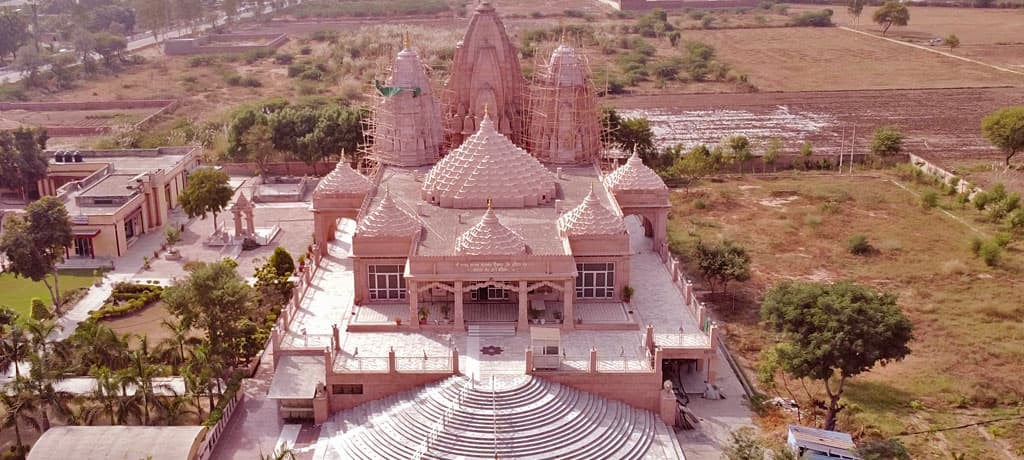
Punyodaya Tirth Atishay Kshetra Hansi
A large number of people visit these miraculous and extraordinary idols everyday to receive blessings for fulfilling their desired wishes.
The "Shri 1008 Parshvanath Digambar Jain Atishay Kshetra Samiti" successfully completes all the activities of the temple. The members of the committee are :
Introduction
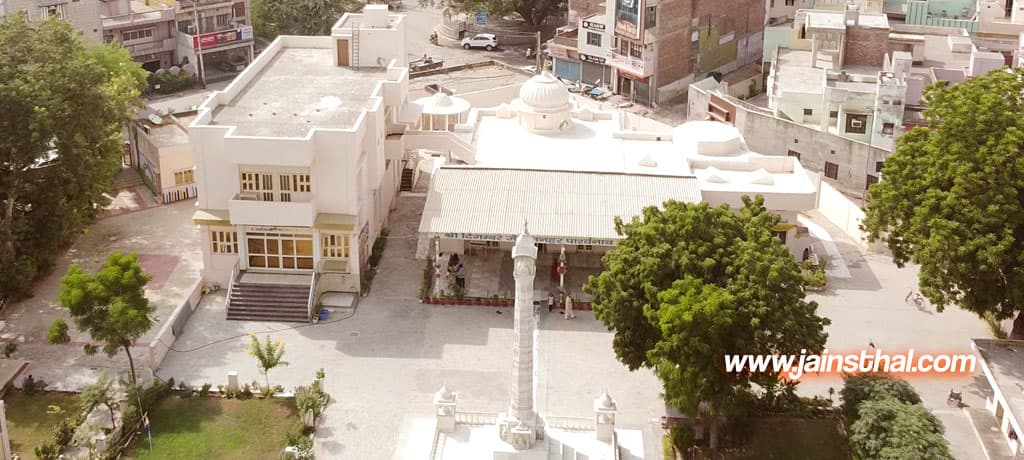
Shri 1008 Bhagwan Parshvanath Digambar Jain Atishay Kshetra, known as 'Punyodaya Tirth', is located in Hansi, Haryana, approximately 25 kilometers from Hisar district and about 110 kilometers from Delhi. Initially, a Vedi (altar) was established within the temple premises, and some Prachin Pratima (ancient idols) were brought here from the Panchayati Jain Mandir, Hansi. Subsequently, the foundation stone of this temple, was laid on March 8, 1995, under the guidance of Acharya Shri 108 Vidyasagar Ji Maharaj, by his foremost disciple Aryika Shri 105 Dridhamati Mata Ji, along with 17 Aryikas and 108 Brahmacarini sisters. Acharya Shri 108 Vidyasagar Ji Maharaj named this Kshetra as 'Punyodaya Tirth', signifying the rise of spiritual merit for those who visit here. The construction of the Garbh Grah (sanctum sanctorum) was completed in 2014. However, the temple awaited the arrival of Muni Shri for the Panchkalyanak (consecration ceremony). The Panchkalyanak of the temple took place in November 2017 in the presence of Muni Shri Pranamya Sagar Ji, Muni Shri Chandrasagar Ji, Muni Shri Veer Sagar Ji, Muni Shri Vishal Sagar Ji and Muni Shri Dhaval Sagar Ji. The Panchkalyanak was organized under the presence of these five Muni Raj. The donation of the land for the construction of the temple was facilitated by Lala Balvant Singh Jain Ji and Shri Shripal Jain Ji. The temple covers an area of seven acres. In the temple precincts, there is an open courtyard adorned with large trees and various flowering plants, enhancing the grandeur of the temple. A majestic, 71-feet-tall Manastambh stands outside the temple, further enhancing its magnificence. Twenty-four semi-circular steps have been constructed outside the temple's Garbh-Grah, leading to the main hall. Upon entering the main hall of the temple, one experiences a profound sense of tranquility. The Garbh-Grah of the temple houses three Vedi (altars). The Moolnayak Pratima (main deity’s idol) in the temple is of Shri 1008 Parshvanath Bhagwan along with two other Pratima made of Ashtadhatu (eight metals). On the left side of the Mool (main) Vedi, in the second Vedi, Shri 1008 Parshvanath Bhagwan’s Chaubisi Pratima is enshrined in the form of a Moolnayak Pratima. This idol resembles the idol of Shri 1008 Adinath Bhagwan, enshrined in Ranila Ji, thus indicating its antiquity. There are a total of 13 idols enshrined in the Vedi, all of which were initially established in the temple. Five of these idols are approximately two thousand years old and were obtained from the Asigarh Fort among the 57 Pratima. The event of these idols being discovered is extremely fascinating and significant. Out of the 57 idols, the remaining 52 idols can be seen in the Panchayati Jain Mandir in Hansi, where the idols are enshrined. In the third Vedi of the temple, the idols of the Panch Balyati Bhagwan Ji are enshrined, which are made of Ashtadhatu (eight metals). These idols include Shri Neminath Bhagwan Ji, Shri Vasupujya Bhagwan Ji, Shri Parshvanath Bhagwan Ji, Shri Mallinath Bhagwan Ji, and Shri Mahavir Bhagwan Ji. All these idols are adorned with beautiful golden artwork on all the altars, which looks very enchanting to behold.
“A large number of people visit these miraculous and extraordinary idols everyday to receive blessings for fulfilling their desired wishes.”
In the temple complex, there is also the Vedi of Kshulak Kulbhushan Ji, who later became Jain Muni Shri Dharmasagar Ji Maharaj, whose Charan Paduka is also enshrined here. It is said that he took a vow that until the 57 idols obtained from the Asigarh Fort, which were confiscated by the Archaeological Survey of India, were not given to the Jain community, he would abstain from sweets and salt. The struggle to obtain the idols for nearly 10 years continued until all the idols were finally obtained, after which everyone enthusiastically and zealously established them in the Shri Digambar Jain Panchayati Mandir.
Atishay Katha
This incident dates back to January 19, 1982. Some children were playing Gulli-Danda near the fort. While playing, one of them hit the Gulli hard, causing it to fly into the air and fall into a pit. The child standing by the edge of the pit went down to retrieve the Gulli and noticed that it had landed on an object resembling a mound of soil. He called all his friends, and together they started removing the soil with their hands, revealing the mouth of the object. It turned out to be a very large pitcher buried in the ground. The children informed their families about the incident. People broke the lock on the pitcher with an iron rod, and upon opening it, they discovered numerous idols inside.
A total of 57 idols were found in the pitcher, including 40 large-sized idols and 17 smaller ones. Among them, 19 idols were exceptionally beautiful representations of Shri Parshvanath Bhagwan. Overwhelmed by the discovery, the children decided to take all the idols home. The next day, there was a dispute over the distribution of the idols among the families. The police got the information about the incident, and they took all the idols to the police station. When the idols reached the police station, the Jain community came to know that Jain idols had been found at the fort. The Jain community gathered there. At the request of the Jain community, all the idols were temporarily placed in the Panchayati Mandir for a day, where devotees gathered from far and wide to see them. The next day, all the idols were handed over to the Archaeological Department. Despite many efforts, the idols were not returned to the Jain community.
For ten years, the government kept these idols preserved. However, due to the relentless efforts of the Jain community and the tireless endeavors of Jain Acharya Param Pujya Shri 108 Dharmabhushan Ji Maharaj, the former Kshulak Shri Kulbhushan Ji Maharaj, and other saints for almost ten years, the idols were finally returned to the Jain community by the government. Kshulak Kulbhushan Ji, who later became a Jain Muni, had the sentiment that until these idols were returned to the Jain community, they would abstain from sweets and salt. After ten years of rigorous penance and efforts, in December 1991, all the idols were returned to the Jain community. Five idols were placed in Punyodaya Tirth Hansi, while the rest were safely enshrined in the Panchayati Digambar Jain Mandir.
After so much struggle, the idols were finally recovered by the Jain community. The idols were established in the Panchayati Mandir in Hansi. As the temple was very ancient, there were no proper security measures in place. Over time, discussions started among people that each idol placed in the area was worth millions. Therefore, there were concerns about security. This information also reached to some thieves, and in 2004, they decided to steal the idols. They broke the roof of the temple and entered to steal all the idols. This information reached Mr. S.P. Saurabh Singh, who was the Superintendent of Police at that time. He investigated the matter and within a month, he managed to track down the thieves and recover the idols. Some idols were found hidden in a water tank named, Mahavir water tank in Hisar, and some were found hidden in a tea shop in front of the Bhiwani police station. This incident led to the recovery of the idols by the Jain community. After the recovery of the idols, the construction work of Punyodaya Tirth began, where five idols were established there.
Dharamshala
In Hansi city, there is a community of about 60 Jain families who come to the temple every day for darshan. A Tyagi Virt Ashram has also been constructed in the temple premises, which has arrangements for accommodation for 2 pratimadhari and 3 pratimadhari devotees. For the relaxation of pilgrims coming from outside, there are 10 AC rooms and 12 non-AC rooms available here. A canteen facility is also arranged here. If you inform them about your arrival before coming to the temple, arrangements for meals are also made here.
History
Hansi has a very ancient history. There used to be a huge sword-making factory inside Hansi Fort. The swords made here were famous throughout the region. In Persian, a sword is called "asi," hence the place was known with the name of Asigarh. Later, it became distorted to Hansi. The Tomar dynasty rulers ruled here until 1153 CE. Later, the area was conquered by the ancestors of the famous emperor Prithviraj Chauhan, the Chauhan king Visaladeva. During the Chauhan period, Jainism became the dominant religion in Hansi. At that time, there were magnificent Jain temples along with the idol of Lord Parshvanath in Hansi. In 1893 CE, thumb-shaped copper coins were found in the village of Masudpur, dating back to the era of Muhammad Shah and Ghiyasuddin. National Highway 9 passes through Hansi, connecting it to Rohtak and Delhi on one side and Hisar, Fatehabad, and Sirsa on the other. National Highway 148B connects Hansi to Barwala, Tohana, Jakhal, Budhlada, Mansa, Bhiwani, and Bathinda.
Know something about this temple?
Spot something missing or incorrect, or have extra info to share? Let us know and our team will take a look.
The "Shri 1008 Parshvanath Digambar Jain Atishay Kshetra Samiti" successfully completes all the activities of the temple. The members of the committee are :