
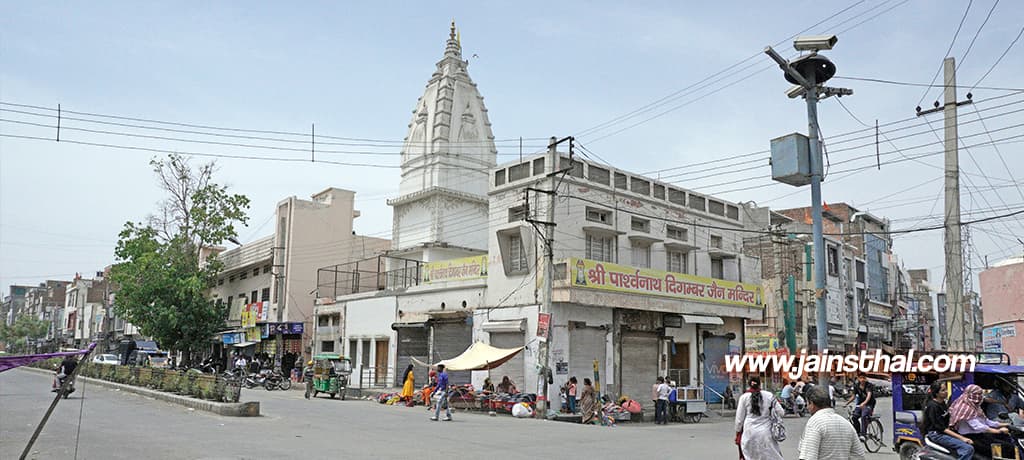
Parshvanath Jain Mandir Sirsa
The woman herself stated that she never expected to get the job of a judge and that it was only due to the blessings of the Bhagwan that this miracle happened.
A temple committee has been formed for the smooth functioning of the temple. The members working in the committee of Mandir ji are as follows -
Introduction
Shri 1008 Parshvanath Digambar Jain Mandir is located in the Sirsa district of Haryana, near National Highway 9. It is the only Digambar Jain temple in the entire Sirsa region. The temple was constructed in 1954 and is managed by the local Jain community. Before the construction of this temple, there was no other Digambar Jain temple in the area. Approximately one kilometer from the temple, there used to be an ancient Chaityalaya, in the home of a local Jain resident, Shri Kulbhushan Sarawgi Ji, built by their ancestors. People had to visit the Chaityalaya for darshan, but due to its small size and congested place, the local Jain community, with the consent of Shri Kulbhushan Ji, decided to build a new temple. The entire Jain community of Sirsa came together, selected the land, and constructed the temple.
After the construction of the temple, the idols that were enshrined in the Chaityalaya were relocated to the present temple. In 1954, Shri 108 Gyanbhushan Ji Maharaj visited the area, and under his guidance, the first Panchkalyanak (consecration ceremony) was conducted in the temple. The Mool Vedi (main altar) of the temple houses the Moolnayak Pratima (main deity’s idol) of Shri 1008 Parshvanath Bhagwan. Alongside him, there are also idols of Shri 1008 Adinath Bhagwan, Shri 1008 Mahavir Bhagwan, and several other idols made of Ashtadhatu (eight metals). These Ashtadhatu idols, which appear ancient, were brought from the Chaityalaya and placed on the temple's Vedi. It is said that these idols were discovered from the Bhu-Garbh (underground) of ancient Sirsa and are approximately 1,400 years old.
In addition to the Mool Vedi, there is also a separate Vedi in the temple where the idols of Mata Padmavati and Dharanendra Dev Ji are enshrined. Every day, members of the Jain community come to the temple to perform rituals such as Puja, Abhishek and Shantidhara.
Atishay Katha
In 1954, Shri 108 Gyanbhushan Ji Maharaj arrived in Sirsa. As Digambar saints traditionally remain in a state of Digambar (complete renunciation), a local person mocked Maharaj Ji for his appearance and laughed at him. Suddenly, a miracle occurred, and the person lost his eyesight, plunging him into darkness. Realizing his mistake, he deeply repented and begged Maharaj Ji for forgiveness, vowing never to behave in such a manner again. Then, another miracle happened, and the person's eyesight was restored. It is said by the local community that sincere prayers at the temple are always answered. There was a woman who used to visit the temple every day and worship Mata Padmavati. After some time, she was appointed as a judge.
“The woman herself stated that she never expected to get the job of a judge and that it was only due to the blessings of the Bhagwan that this miracle happened.”
Dharamshala
In Sirsa, there is a community of about twenty to twenty-five Digambar Jain families. Despite being a small community and having only one Digambar Jain temple in the entire region, devotees from far and wide visit the temple. Among the notable visitors to the temple were the parents of Indian Air Force officer Wing Commander Abhinandan Varthaman, a national hero. Additionally, social media motivational speaker Shri Harshvardhan Jain has also visited the temple.
In Sirsa, both the Digambar and Shwetambar Jain communities support each other in their activities. This single Digambar Jain temple in Sirsa is efficiently managed by the Jain community. If any pilgrim from another region comes to visit the temple, accommodation is arranged for them at the Shwetambar Dharamshala located in Sirsa.
History
Sirsa is a district located in the southern part of Haryana state, bordering Rajasthan's Hanumangarh district on one side and Punjab on the other. The history of Sirsa city is ancient and illustrious. The ancient name of Sirsa was "Sirshuti," and in some places, it is also found as "Shiriska." The name "Shiriska" is mentioned in the ancient text *Ashtadhyayi* by Rishi Panini. Over time, the name Sirsa became widely known. Sirsa was also known as "Van Nagari" (City of Forests), "Saras Nagari" (City of Cranes), and "Sant Nagari" (City of Saints). Today, Sirsa has become the largest district in Haryana in terms of area.
Sirsa has a deep spiritual connection. This land, surrounded by the cool breeze of spirituality, has been home to numerous saints and mystics. Thousands of years ago, during their exile, two of the five Pandavas, Nakula and Sahadeva, spent part of their exile here. The Sirsa region, along with its surroundings, is a treasure trove of rich historical and cultural heritage. This was discovered by the Archaeological Survey of India during excavations at 54 sites near the Ghaggar River in 1967 and 1968. These excavations uncovered various colorful and intricately designed pottery and bowls belonging to the Rang Mahal culture.
In 1789, a natural calamity turned the original Sirsa city, located southwest of the present city, into ruins. Until about five decades ago, Sirsa was a semi-desert area prone to dry, dusty black and yellow storms. Therefore, the story of Sirsa's development can be seen as a transformation from desert aridity to greenery. After the Bhakra Dam project, the lush green fields, orchards, and electrified villages in this once desert region tell the story of the district's development.
Know something about this temple?
Spot something missing or incorrect, or have extra info to share? Let us know and our team will take a look.
A temple committee has been formed for the smooth functioning of the temple. The members working in the committee of Mandir ji are as follows -