
Narnaul Shantinath Atishay kshetra
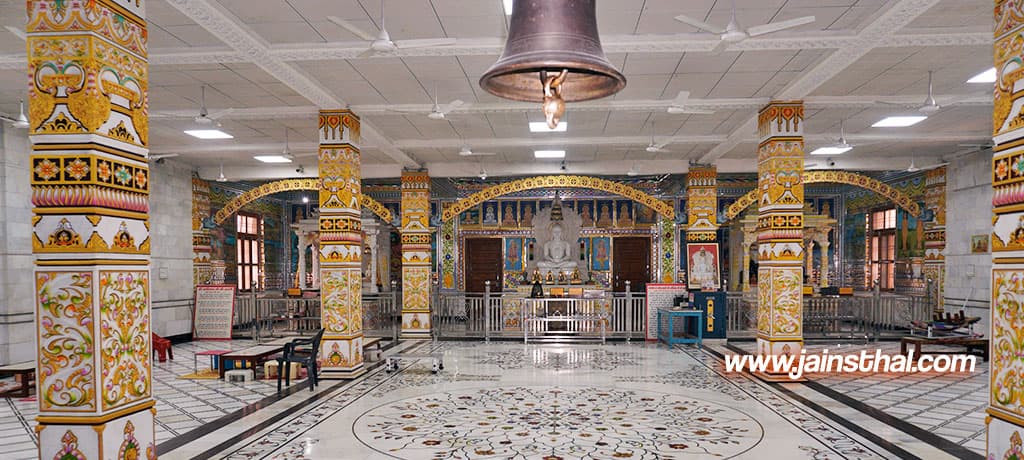
Shri 1008 Shantinath Digambar Jain Atishay Kshetra is located in Narnaul, Haryana, about twenty-five kilometers away from Mahendragarh district.
The temple committee has been formed for the efficient management of the temple. The active members of the committee are as follows :
Introduction
“Shri 1008 Shantinath Digambar Jain Atishay Kshetra is located in Narnaul, Haryana, about twenty-five kilometers away from Mahendragarh district.”
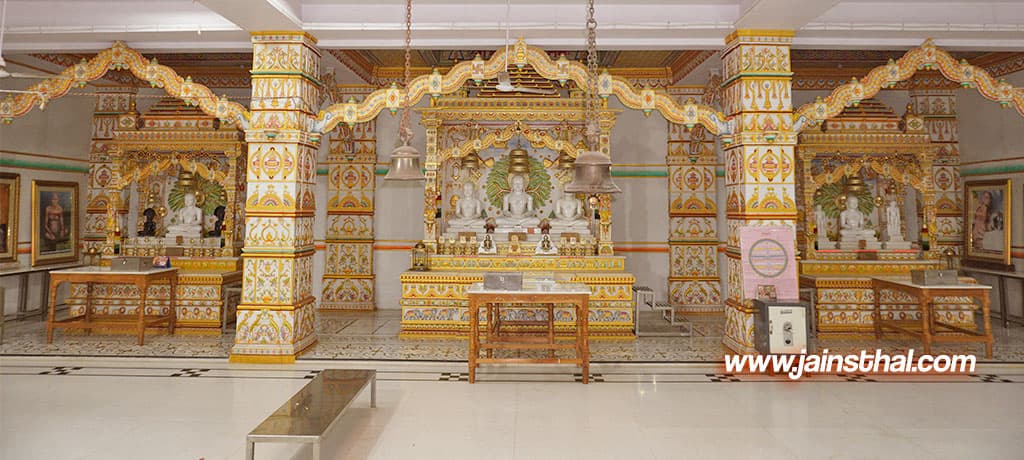
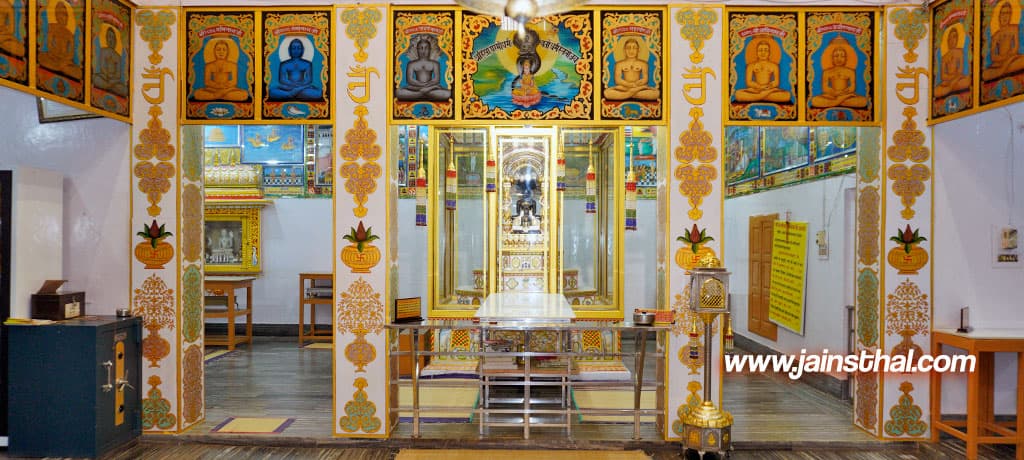
Approximately a century ago, the throne of Bhattarak Sahastra Kirti Ji was established at the site of the temple, and a temple was built by him. Exactly a hundred years ago, at a distance of fifteen kilometers from Narnaul, the idol of Shri Adinath Bhagwan manifested from the Doshi River. Due to Narnaul being on the border of Rajasthan, there was a serious discussion between the Jain communities of Rajasthan and Narnaul regarding the acquisition of the idol. The entire Jain community then approached the king and presented their case before him. A decision was made by the king to safely place the idol on a bullock cart and leave it. It was decided that in the direction the bullock cart would go, the idols would be handed to the Jain community of that area. The idol was safely placed on the bullock cart, which eventually stopped at Narnaul, where the idol was then established in the Chaitalya of Bhattarak Sahastra Kirti Ji. Over time, the Chaitalya was renovated by the Narnaul Jain community and transformed into the form of a temple. In the year 2011, Acharya Shri 108 Surdev Sagar Ji arrived at the temple. At that time, the faces of the idol were not towards the entrance of the Garbh Grah (sanctum sanctorum). Upon seeing the Pratima, he suggested to the Jain community that the faces of the idols should be towards the main entrance of the Garbh Grah. The Jain community changed the entrance door of the Garbh Grah, aligning it with the faces of the idol. Then in the year 2013, again the idol of Shri Shantinath Bhagwan emerged from the Dhosi River. The Jain community brought the idol to the temple and enshrined it. In the year 2014, on the occasion of swarn jayanti samaroh of Acharya Shri 108 Vishad Sagar Ji Maharaj, the reconstruction work of the temple was initiated. After the completion of the construction work, in 2019, the Panchkalyanak happened in the temple. Other Vedi (altar) were also constructed in the temple, where the idol of all prachin (ancient) and new deities were established. During the Panchkalyanak, a magnificent Manstambh was also constructed in front of the temple. Currently on the ground floor of the temple, there are five Vedi where various deities are enshrined, including the Mool Vedi (main altar) of the temple. The Mool Vedi houses the Pratima of Shri 1008 Shantinath Bhagwan Ji. Along with the Pratima of Shri Shantinath Bhagwan Ji, other newly established pratima of Shri Adinath Bhagwan and Shri Mahavir Bhagwan are also seated in the Vedi. On the side of the Mool Vedi, the Vedi of Shri Adinath Bhagwan Ji, adorned with the most ancient idol of the temple. This idol is the one that was excavated by the Jain community from the Dhosi river 100 years ago. Due to the absence of the symbol and inscriptions on the idol, people used to consider it as the idol of Shri 1008 Shantinath Bhagwan. Hence, the temple was named as Shri 1008 Shantinath Digambar Jain Mandir. During the year 2014, when Acharya Shri 108 Vishad Sagar Ji Maharaj visited the area, he identified the idol as belonging to Shri Adinath Bhagwan Ji due to its distinct features. In this Vedi, along with the Mool Pratima, there are also two white stone idols of Shri Parshvanath Bhagwan Ji and Chaubisi pratima made of Ashtadhatu (eight metals) seated along with other ancient idols. Adjacent to the Mool Vedi is the Vedi of Shri 1008 Kunthunath Bhagwan Ji. In this Vedi, along with the Chaubisi pratima of Shri Parshvanath Bhagwan Ji, there are two other ancient idols made of Ashtadhatu and Stone along with the idol of Shri Neminath Bhagwan Ji. On the same floor, there are Vedi dedicated to Padmavati Mata Ji and Kshetrapal Baba Ji. Upon entering the upper floor of the temple, one can witness the grand Samosharana of Shri Shantinath Bhagwan Ji, that too was recovered as a whole from the Dhosi River in 2013. Despite being ancient, the Samosharana of Shri 1008 Shantinath Bhagwan Ji is exceptionally well conserved, and quite rare to witness. Along with the Samosharana, the Idols of the Khadgasana Choubisi and Khadgasana Navagraha are also installed in three Vedi, providing extraordinary and divine sightings. White marble has been used in the construction of the temple, which captivates attention from a far due to its elegance. From time to time, Jain saints have visited the area and blessed the community with their darshan. Alongside the temple, there is also a Jain dharamshala. When Jain saints visit, arrangements for their stay are made in the dharamshala. Free accommodation is provided in the dharamshala for pilgrims coming from distant areas to visit the temple.
Dharamshala
In Narnaul, there are approximately 150 Jain families. Despite being a society of 150 families, the Jain community actively contributes to every kind of social activities. There are a total of three Digambar Jain Mandir in Narnaul. The different Committees have been formed in all the Jain temples in Narnaul and the management of the temple is done by the respective committee. The committee ensures cleanliness for the devotees visiting the temple. Jain Saints keep visiting the temple from time to time. For their stay, arrangements are made in the Sant Bhavan. There is also a Jain Dharamshala in the area, which is made available to people from the Jain as well as any other community for auspicious occasions. If any Jain pilgrim comes to visit the temple from a distant area, arrangements for their stay are made free of cost in the Jain Dharamshala.
History
Narnaul is a city located in the Mahendragarh district of the Indian state of Haryana. It also serves as the headquarters of the district. The name "Narnaul" is mentioned in an ancient inscription found in the Prachin Surya Narayan Mandir, where it is referred to as "Nandigram." The Shrimad Bhagwat Puran also mentions Nandigram; hence, the city is often referred to as belonging to the Dwapar era. According to tradition, around a thousand years ago, Raja Noonkaran, a relative of the Delhi ruler Anangpal Tomar, established this city. During Raja Noonkaran's reign, Narnaul was known as a commercial center. The Mughal Emperor Babur mentioned in his memoir "Tuzk-e-Babri" the presence of a cotton market here, indicating the cultivation of cotton in the region. According to the 2001 Census of India, the population of Narnaul was 74,581. The population comprised 53% males and 47% females. The average literacy rate in Narnaul is 68%, which is higher than the national average of 59.5%. Hindi and Ahirwati are the major languages spoken in Narnaul.
Know something about this temple?
Spot something missing or incorrect, or have extra info to share? Let us know and our team will take a look.
The temple committee has been formed for the efficient management of the temple. The active members of the committee are as follows :