
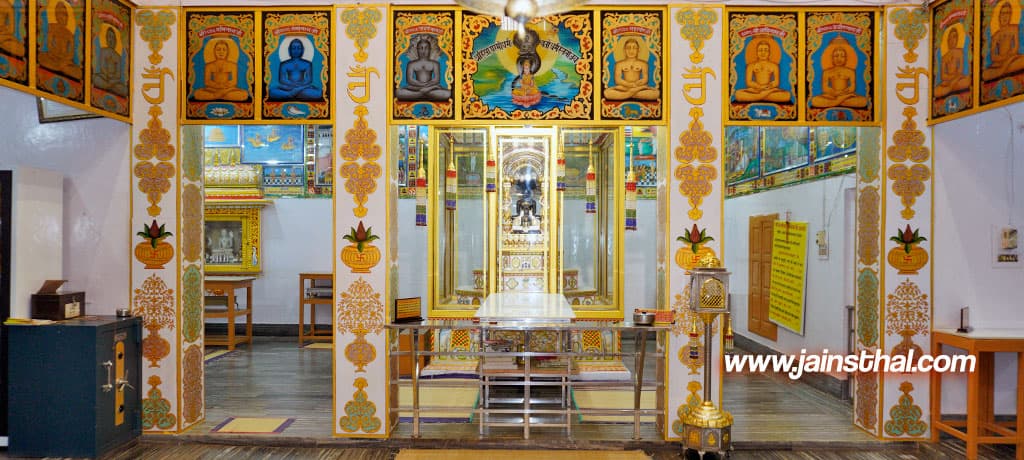
Narnaul Parshvanath Digambar Jain Mandir
It is also believed that about a thousand years ago, during the reign of Anangpal Tomar, a relative of the Delhi ruler, Raja Nunkaran, established this city.
The temple committee has been formed for the proper management of the temple. The active members of the committee are as follows:
Introduction
Shri 1008 Parshvanath Digambar Jain Mandir in Narnaul is located near the Shri 1008 Shantinath Digambar Jain Mandir. Adjacent to the temple are also a Hindu temple dedicated to Bhagwan Shiva and a mosque (masjid). Despite being places of different religious faiths, people from all communities respect and honor each other and live harmoniously. The construction of the temple was initiated by Seth Ganeshilal Jain in the year 1982. Seth Ganeshilal was not only prosperous but also had a saintly nature. He and his family had a special interest in religion. Due to their strong religious beliefs, they undertook the construction of the temple. Seth Ganeshilal Jain donated eighteen shops, a dharamshala (religious shelter), and the temple premises to the Jain community in the year 2019. Currently, the management of the temple, dharamshala, and shops is overseen by the Jain community.
Around the years 1983-1984, there was a barber named Brahm Datt in the area. He was known for his simple nature and respect for everyone. Once, during the construction work at his house, an ancient idol of Shri 1008 Parshvanath Bhagwan was unearthed from the wall. Although Brahm Datt was not a Jain by faith, he respected all religions. He handed over the idol to the Jain community. It is said that as long as he lived, he personally performed worship and rituals for the idol according to Jain customs.
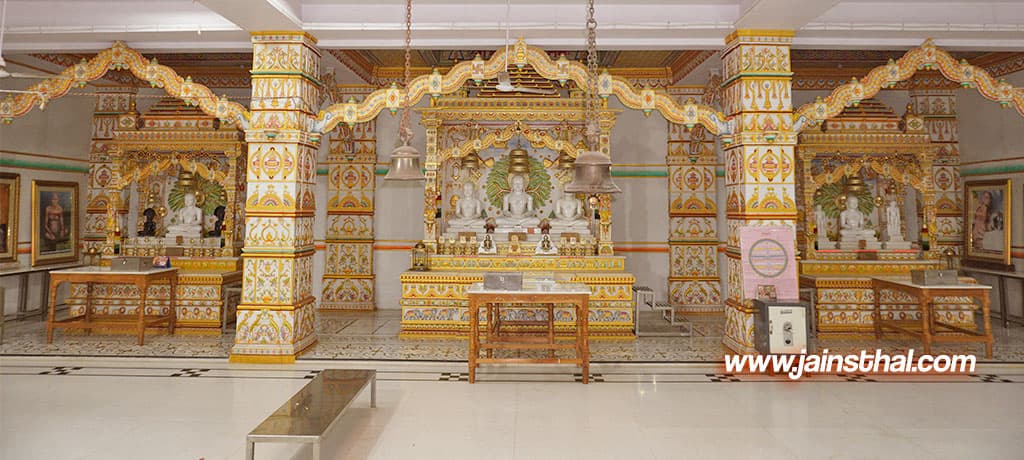
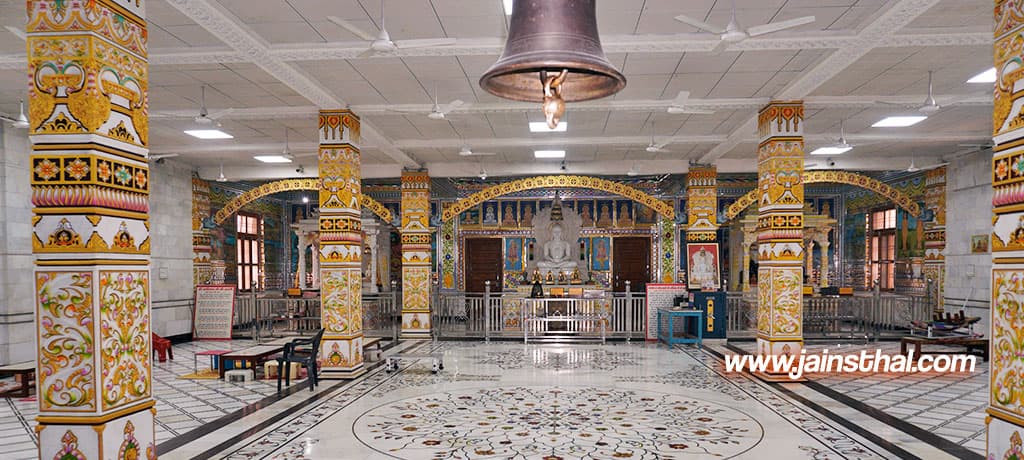
The Moolnayak Pratima (main deity’s idol) in the Vedi (altar) of the temple is the Prachin Pratima of Shri Parshvanath Bhagwan. Along with this idol, there is another idol of Shri Parshvanath Bhagwan made of Ashtadhatu (eight metals). In the second Vedi of the temple, the Moolnayak Pratima is of Shri Shantinath Bhagwan. Along with the idol of Shantinath Bhagwan, there are also idols of Shri Parshvanath Bhagwan, Shri Chandraprabhu Bhagwan, Shri Mahavir Bhagwan, and other Tirhtankars. In the third vedi, there are the idols of Khadgasana posture of Shri Adinath Bhagwan and Bharat-Bahubali Bhagwan. Adjacent to the Vedi of Adinath Bhagwan, there is a separate Vedi dedicated to Mata Padmavati Ji. Inside the Garbh Grah (sanctum sanctorum) of the temple, the Jain scriptures are beautifully depicted through paintings, creating an atmosphere of spiritual energy upon entering the Garbh Grah.
Dharamshala
In Narnaul, there are approximately 150 Jain families. Despite being a small community, the Jain society actively contributes to social activities. There are a total of three Digambar Jain temples in Narnaul, all of which have been constructed with the support of the community. The management of these temples is overseen by committees. The committees ensure cleanliness and purity for the devotees visiting the temples. Jain Saints often visit the temples, and arrangements are made for their stay in Sant Bhavan. Additionally, there is a Jain dharamshala in the area, which is made available not only to Jain community members but also to others for auspicious occasions. If Jain pilgrims come from distant areas to visit the temples, arrangements are made for their stay free of cost in the Jain dharamshala.
History
Narnaul is a city located in the Mahendragarh district of the Indian state of Haryana. It serves as the headquarters of the district and is known for its historical significance. According to an ancient inscription found in the ancient Surya Narayan Temple, its name was mentioned as Nandigram. Shrimad Bhagavat Purana also makes a reference to Nandigram, hence it is often referred to as a city from the Dwapara Yuga. According to ancient stories, Narnaul was known as Nararashtra during the Mahabharat period.
“It is also believed that about a thousand years ago, during the reign of Anangpal Tomar, a relative of the Delhi ruler, Raja Nunkaran, established this city.”
During Raja Nunkaran's time, Narnaul was known as a commercial center. The Mughal Emperor Babur mentioned the presence of a cotton market in his memoir "Tuzuk-e-Babari," indicating that cotton farming was prevalent here. In the 15th century, Narnaul came under the control of the Sur Afghans after passing from the hands of the Mughals. Initially, Sher Shah Suri's grandfather, Ibrahim Khan, arrived here. After Ibrahim Suri's death, his son and Sher Shah Suri's father, Hasan Khan, became the jagirdar of Narnaul. According to historian V. Smith, Sher Shah Suri was also born in Narnaul. As per the 2001 Indian Census, the population of Narnaul was 74,581. The population consisted of 53% males and 47% females. The average literacy rate in Narnaul is 68%, which is higher than the national average of 59.5%. Hindi and Ahirwati are the primary languages spoken in Narnaul.
Know something about this temple?
Spot something missing or incorrect, or have extra info to share? Let us know and our team will take a look.
The temple committee has been formed for the proper management of the temple. The active members of the committee are as follows: