
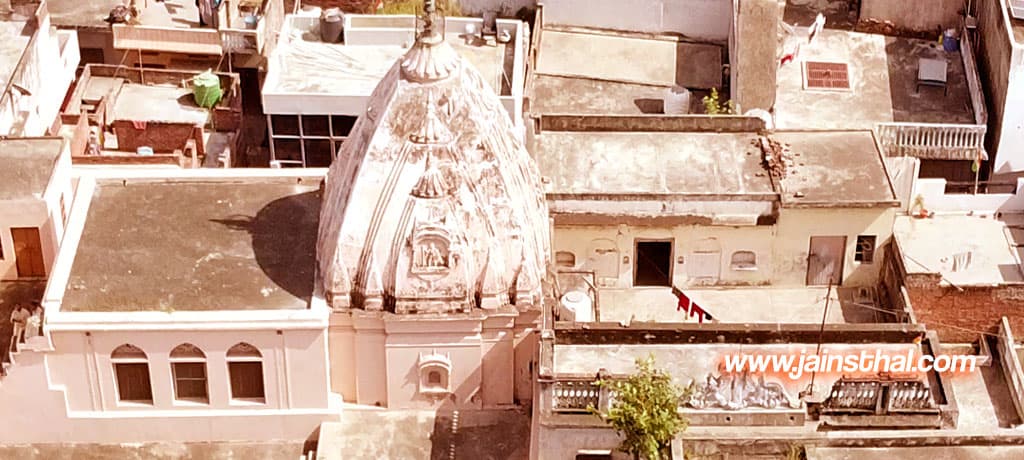
Jansath Prachin Panchayati Mandir
It is believed that the deity is protecting it.
Despite the small number of Jain community in the area, the operation of the temple runs smoothly. The members engaged in the service of the temple are as follows :
Introduction
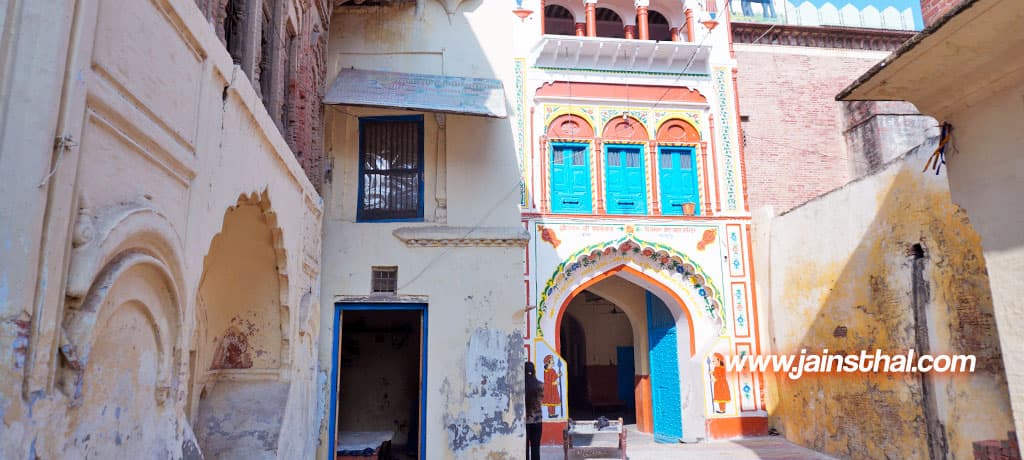
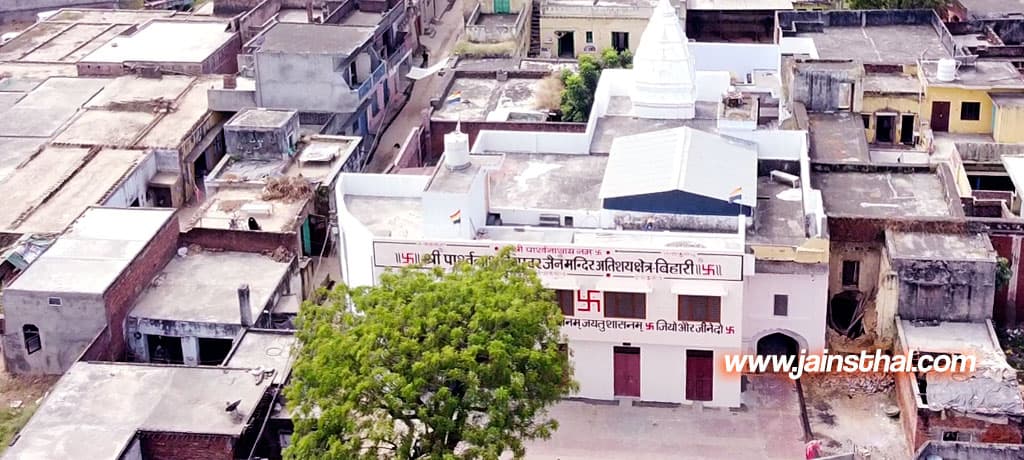
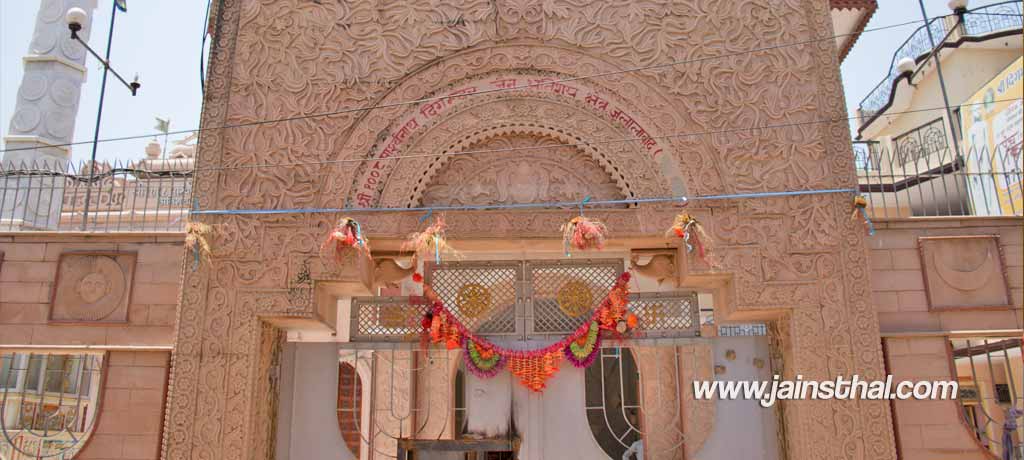
Shri 1008 Chandraprabhu Digambar Jain Panchayati Mandir is located in Jansath, 15 km away from Muzaffarnagar district of Uttar Pradesh. It is situated 12 kilometers from Khatauli and 32 kilometers from Hastinapur. Positioned amidst the main market of Jansath, the temple comprises three Vedi (altar). In the center of Mool Vedi (main altar), lies the Moolnayak Pratima (main deity’s idol) of Shri 1008 Chandraprabhu Bhagwan, adorned with an ancient and captivating black stone idol. The idol, crafted from black stone, is exceptionally rare, as most idols of Chandraprabhu Bhagwan are made from white stone. Alongside the Moolnayak Pratima, there are two idols of Shri 1008 Adinath Bhagwan, two idols of Shri 1008 Parshvanath Bhagwan, and one idol of Shri 1008 Padmaprabhu Bhagwan.
On the left side of the Mool Vedi, the Vedi of Shri 1008 Parshvanath Bhagwan’s is established, accompanied by idols of Shri 1008 Suparshvanath Bhagwan and Shri 1008 Shantinath Bhagwan. On the right side of the Mool Vedi, the Vedi Shri 1008 Neminath Bhagwan’s is established, accompanied by idols of Shri Bahubali Bhagwan, Shri 1008 Parshvanath Bhagwan’s two idols, Shri 1008 Mahavir Bhagwan’s two idols, Siddhanath Bhagwan, and Shri 1008 Anantnath Bhagwan. It is said that the idols established in both the Vedis were originally embedded within the walls. Over time, these idols were retrieved from the walls, and reinstated in the Vedi. Almost all idols in the temple are ancient, yet they appear remarkably well-preserved. The arrival and departure of Digambar and Shwetambar Saints from Hastinapur to this temple are particularly significant.
Atishay Katha
It is said that inside the Jansath temple, there is still a Bhu-Garbh, where another temple might be located.
“It is believed that the deity is protecting it.”
This perception has also been experienced by Jain devotees and other Jain Saints, who come here for darshan. In the year 2021, the community initiated the excavation work of the temple. However, due to some reasons, this work had to be stopped. Perhaps the appropriate time for the idols to come out has not arrived yet, or it might be a sign from the deities themselves. It is hoped that in the future, through the virtuous efforts of the Jain community, these idols will be brought out from underground by some Saints and will be reinstated for the darshan.
Jain Samaj
According to local residents, there used to be a Jain community of 100 families here at one time. Today, only three families remain in the community. There is a small hall in the temple. Accommodation is provided in five rooms with a shared bathroom facility. Food arrangements for pilgrims are also made available here by the Jain community.
History
Muzaffarnagar covers an area of 4049 square kilometers. Situated approximately 116 kilometers away from Delhi, it lies in the western part of Uttar Pradesh, bordering Haryana and Rajasthan. Positioned along National Highway 58, within the Saharanpur Division, it lies amidst the confluence of the Ganga and Yamuna rivers. It is renowned for various religious sites. The area boasts several pilgrimage destinations like Shukratal, Tanda, Amba Bara, Bhithouda, and Mandira Ghat, all situated at the confluence of the Ganga and Yamuna rivers. The region hosts numerous festivals and fairs, making it a significant cultural hub. Muzaffarnagar is home to several ancient palaces and royal residences, which hold historical significance and are popular among tourists. While Hindi and Urdu are the primary languages spoken here, other languages like Haryanvi and Rajasthani are also prevalent.
Muzaffarnagar is a significant industrial city, renowned for its production of sugar, iron, paper, and handcrafted suits for women. It is a major hub for grain production, with the majority of its population engaged in agriculture, constituting over 70% of the district's total population. Muzaffarnagar's Gur market is Asia's largest, and it leads in sugarcane production in India, with the highest number of sugar mills located here.
Know something about this temple?
Spot something missing or incorrect, or have extra info to share? Let us know and our team will take a look.
Despite the small number of Jain community in the area, the operation of the temple runs smoothly. The members engaged in the service of the temple are as follows :