
Hastinapur Tirthkshetra Jain Mandir
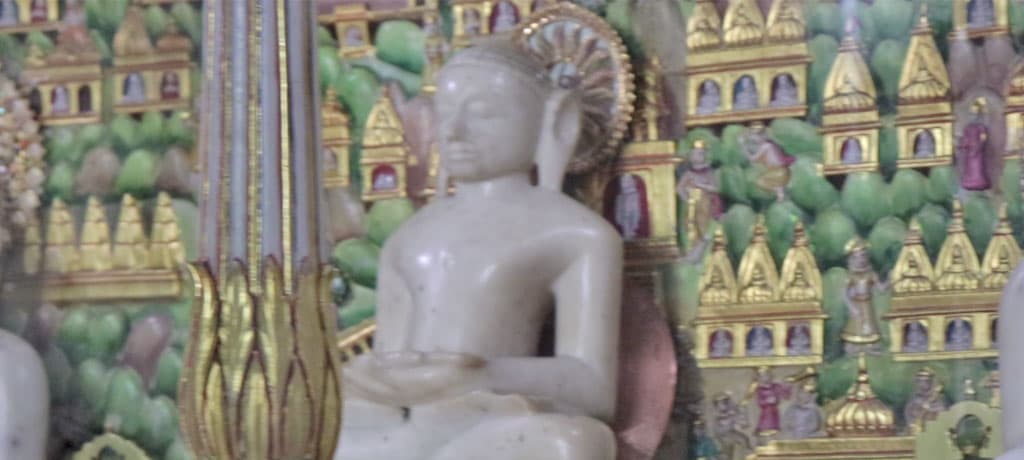
Flower showers are happening from four celestial Vimanas.
The management of the Shri Digambar Jain Bada Mandir is overseen by the Shri Digambar Jain Teerth Kshetra Prabandhakarini Committee, Hastinapur. The members of the committee are as follows:
Introduction
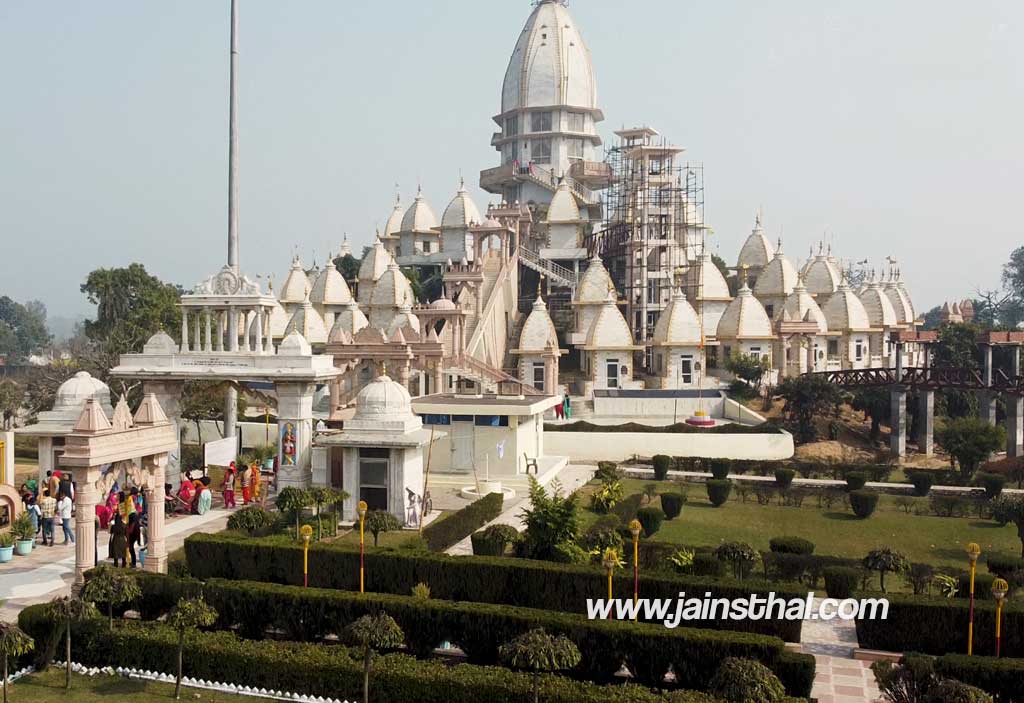
Hastinapur, located 37 kilometers from Meerut district and 100 kilometers from Delhi, is known for its royal, majestic history and its association with the epic Mahabharata, where it served as the capitals of the Pandavas and the Kaurav. It holds immense significance as an ancient Jain pilgrimage site. It is the place where the first Tirthankar, Shri Rishabhdev, took his first Aahar, marking the beginning of the celebration of Akshaya Tritiya. It is also where the 16th Tirthankar, Shri Shantinath, and the 17th Tirthankara, Shri Kunthunath, attained their births, initiation, omniscience, and salvation. Additionally, it witnessed the four auspicious events of the 18th Tirthankar, Shri Aranath. The 19th Tirthankara, Shri Mallinath, and the 23rd Tirthankara, Shri Parshvanath, samavsharan happened here. Located in Dharmanagar Hastinapur, Shri 1008 Digambar Jain Bada Mandir is considered the oldest Jain temple in present-day Hastinapur. Outside the main entrance gate of the temple premises stands a 31-foot tall manastambha, constructed in 1955. The temple consists of only one section, which is quite spacious. Surrounding the central temple, there are smaller temples dedicated to various Jain Tirthankaras. The main temple is constructed with a raised platform of about four feet in height, and railings surround the Temple. The interior of the temple is adorned with golden paintings depicting stories from Jain scriptures. It is said that approximately 7 to 8 kilograms of gold were used in the interior decorations of the temple. The Moolnayak Pratima (main deity’s idol) in the temple is of Shri Shantinath Bhagwan, which is an approximately 500-year-old Padmasana idol made of white marble. This idol attracts a large number of devotees. To the right of the main idol, there are idols of Shri Arhannath Bhagwan and to the left, there are idols of Shri Kunthunath Bhagwan. In the Vedi (altar), there is a Panchbalyati Tirthankar Pratima, where Shri Vasupujya, Shri Mallinath, Shri Neminath, Shri Parshvanath, and Shri Mahavir Swami ji idols are enshrined. Among these, two idols are in Padmasana posture, while two idols are in Khadgasana posture. In the Vedi, there are also two fragmented idols, probably discovered in the forests of Bhargav village in Muzaffarnagar during the Muslim period, which are believed to belong to the Chaturth Kaal, due to the absence of any inscriptions on them. On the left side of the temple, there is a idol of Ambika Devi situated in a chamber. This statue was found during the excavation of the canal. At the top of the idol, Shri Neminath Bhagwan is depicted. Near the Vedi, there is a newly constructed temple of Shri Parshvanath Bhagwan, in which there is a mesmerizing 11.25 feet high, black stone idol seated in a Padmasana posture with 11 hoods. Adjacent to the Parshvanath Mandir stands the grand Nandishwar Dvipa. Nandishwardvipa is constructed in a modern octagonal shape, featuring 52 Chaitayalya and a PanchMeru. Near Nandishwardvipa, there is the Chaitayalya of Shri Neminath Bhagwan. Adjacent to the aforementioned Chaitayalya is the temple of Shri Arhannath, where a Padmasana idol of Shri Arhannath is enshrined. To the right of this temple, in the Vedi, is a magnificent 7.5 feet high idol of Shri Adinath Bhagwan in a Khadgasan posture idol enshrined. Near this temple, there are three more temples, built after the main temple, each having three Vedi. In the left Vedi of the temple, there is a 5 feet 11 inches tall Khadgasana idol of Shri Shantinath Bhagwan, dating back to the Chaturth Kaal. In the Temple, there is a vast Samavasharan of Shri Mallinath Bhagwan, spread across an area of 60x70 feet. With the inspiration of Shri Adisagar Ji Maharaj and the support of the Jain community, in the Samavasaran temple, 992 Chaitalaya and four Manastambhas in all directions are established. In the center, four idols of Shri Mallinath Bhagwan are enshrined, surrounded by eight Indra holding Chhatras.
“Flower showers are happening from four celestial Vimanas.”
Around them, nine Indra Chakras are erected, and twelve Sabhas are created. The entire Samavasharan is made of white marble. The consecration of this Jinalaya was performed on the third day of the bright fortnight of Falgun month in the Vir Nirvaan Samvat year 2420, on Monday, in the presence of Acharya Vidyanand ji Maharaj. Near the Samavasaran temple is the Kunthunath Jinalaya, where a charming marble idol of Shri Kunthunath Ji is enshrined. Nearby, there are also temples of Shri Mahavir Ji and Shri Chandraprabhu Ji, constructed on May 7, 2006. Moving forward to the left side of the temple courtyard, there is a grand temple of Shri Bahubali Ji, where a pink marble statue of Shri Bahubali is enshrined. Along with that, there are also water temples and glory pillars constructed. All these temples are built around the main shrine's perimeter.
Dharamshala
Arrangements for accommodation have been made for the pilgrims visiting the temple. For pilgrims coming from outside, there are 185 rooms available with attached bathrooms and 125 rooms without bathrooms. The total capacity for accommodating pilgrims is 2500. The dining facility in the hostel is also well-managed. On November 4, 1998, on the auspicious occasion of the annual fair, the inauguration of the Shri Acharya Vidyanand Jain Art Gallery was done by Jeevendra Kumar Jain, from Gaziyabad. Additionally, this place features depictions of ancient famous Jain pilgrimage sites and sculptures, showcasing marvelous artwork. In the same hall, under the inspiration of Sadhu Shanti Prasad Ji, the Indian Knowledge Center has displayed a vast literature which serves as an attractive center for all followers and researchers.
The renowned Shri Digambar Jain Utriya Prantiya Gurukul is also situated along this holy stream. The Gurukul was established in 1945 with the inspiration and blessings of Ganesh Prasad Varni Ji and Manohar Lal Varni Ji from Saharanpur. Here, there is a large building with 30 to 40 rooms and a big hall. Along with the school, there is also a hostel for students. Free religious and Sanskrit education is provided to 95 to 100 students here. The meal arrangements for students have been made at minimal cost so that students can receive good nutritious meals. Provision for daily milk and fruits is also made for children.
History
The city of Hastinapur, located in the city of Meerut in the state of Uttar Pradesh, has been renowned as the capital of the Kuru dynasty. However, this region has been an important center of Jain faith even before the Mahabharata era. Hastinapur has witnessed and celebrated various glorious days throughout history. Even today, it is considered one of the major pilgrimage sites in India. Several vast Jain areas have been developed here, where arrangements for accommodation and food have been made efficiently. Some prominent Jain areas in Hastinapur are : the ancient Shri Digambar Jain Bada Mandir, Shri Digambar Jain Mandir Kailash Parvat Rachna, Shri Digambar Jain Mandir Jambudweep Rachna, Shri Digambar Jain Nasia Ji and Shri Ashtapad Shwetambar Jain Teerth.
Know something about this temple?
Spot something missing or incorrect, or have extra info to share? Let us know and our team will take a look.
The management of the Shri Digambar Jain Bada Mandir is overseen by the Shri Digambar Jain Teerth Kshetra Prabandhakarini Committee, Hastinapur. The members of the committee are as follows: