
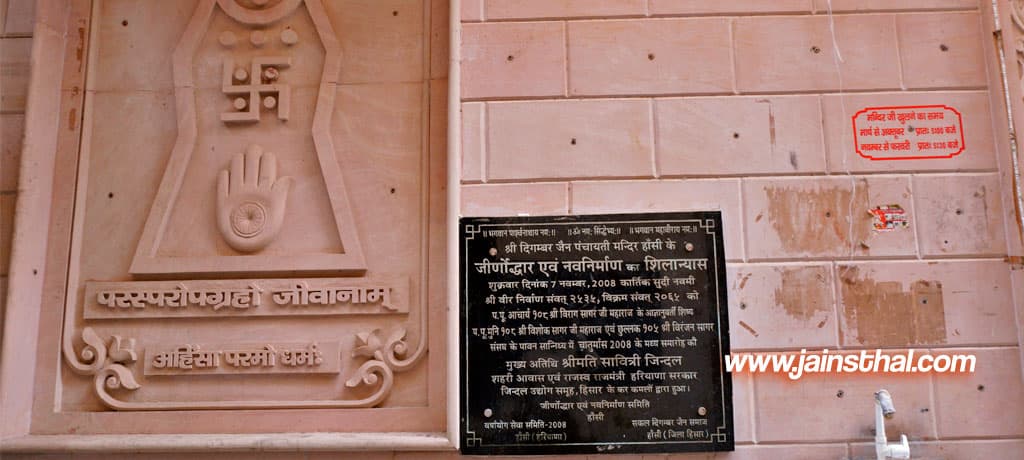
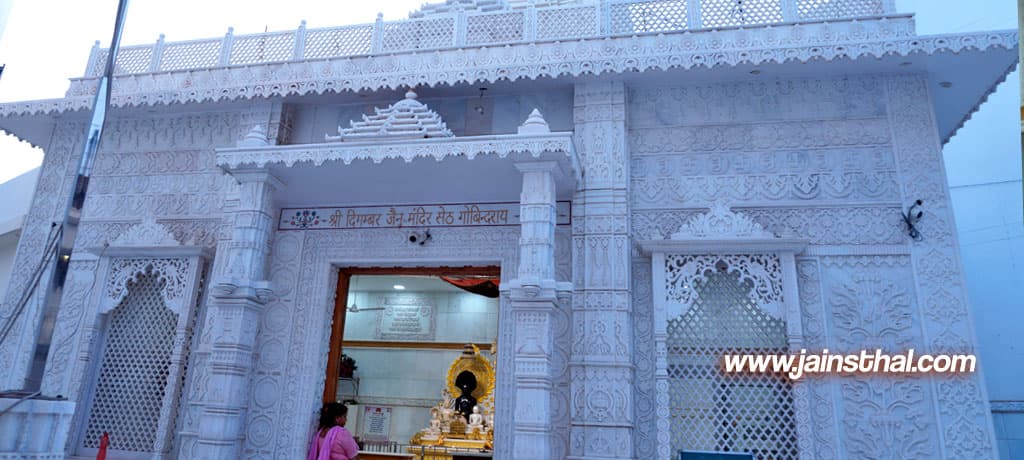
Hansi Prachin Digambar Jain Mandir
Therefore, it was believed that this was an Atishay (divine occurrence), where the idols were anointed by the deities themselves.
There are about 60 Jain families in Hansi. Every day, devotees come in large numbers to the temple to benefit from the darshan of the deity. The Jain community has been contributing to social activities covertly. The current committee members are :
Introduction
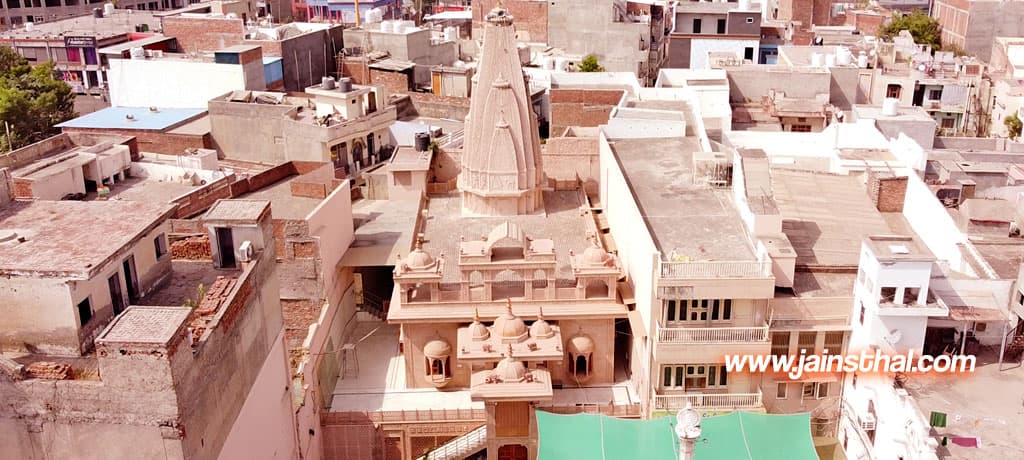
Shri Digambar Jain Panchayati Mandir, Hansi, is situated approximately 3 kilometers from the Atishay Kshetra 'Punyodaya Tirth', around 25 kilometers from Hisar district in Haryana, and approximately 110 kilometers from Delhi. The construction of the temple is believed to have taken place between 1820 and 1825. However, in 2014, when Muni Shri Vishok Sagar Ji Maharaj visited the temple and observed its condition, he ordered for its renovation to be carried out promptly, warning of potential deterioration otherwise. At that time, the Jain community of Hansi, led by Suraj Bhan Jain and Ajit Jain, took the initiative and facilitated the reconstruction of the temple. During the progress of the reconstruction work, two idols and a pair of Charan Paduka emerged from the Bhu-Garbh. Both idols and the Charan Paduka were enshrined in the temple. Although some inscriptions are visible on the Charan Paduka, they have not been deciphered yet.
The temple houses three Vedi (altar), two on the lower floor and one on the upper floor. Upon entering the temple, you will encounter an enchanting Vedi on the right side, where 57 idols obtained from the Asigarh Fort in Hansi are enshrined. During the construction of Punyodaya Tirth, five of these idols were enshrined there. The Moolnayak Pratima (main deity’s idol) in this Vedi is of Shri Parshvanath Bhagwan. Another Vedi on the upper floor also houses the Moolnayak Pratima of Shri Parshvanath Bhagwan, along with other idols. Each Vedi features exquisite golden artwork, which is captivating to behold. Furthermore, numerous beautiful sculptures adorn this temple. All the signs of the 24 Tirthankar have been depicted artistically in this building. In 2008, Muni Shri Vishok Sagar Ji Maharaj, along with his Sangh's Kshulak, Muni Shri Viranjan Sagar Ji Maharaj, observed their Chaturmas here. Aryika Driddhmati Mata Ji and her entire Sangh, comprising 18 Aryikas, also observed their Chaturmas at this temple.
Atishay Katha
During the renovation work of the temple, two idols and a pair of Charan Paduka emerged from the temple's foundation. Along with the temple, there was also a Jain dharamshala (guesthouse). Muni Shri Vishok Sagar Ji Maharaj and Kshulak Shri Kulbhushan Maharaj Ji placed both these idols in one of the rooms of the dharamshala and locked the room. There was only one way to enter the room, which was through the main door from outside. If anyone entered the room from outside, it would be noticeable to everyone. The next day, Kshulak Shri Kulbhushan Maharaj Ji himself opened the door. However, as soon as the door opened, a captivating fragrance spread around. Everyone remarked that such a captivating fragrance could not be from any ordinary perfume. When they entered the room, they saw that there were some drops of milk as well. It seemed as if someone had just performed the Abhishek (auspicious bath of the idol) of the idols with milk. An ordinary person could not enter the room without unlocking it.
“Therefore, it was believed that this was an Atishay (divine occurrence), where the idols were anointed by the deities themselves.”
Dharamshala
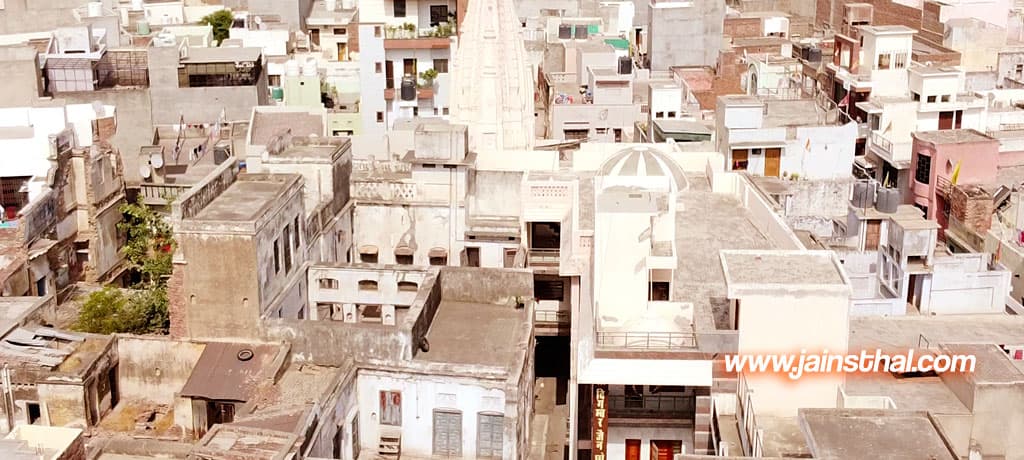
In Hansi, there are approximately 60-65 Jain families. Every day, a large number of devotees come to the temple to benefit from the darshan of the deity. The construction of the Jain Dharamshala was completed in 1953. Shri Digambar Jain Dharamshala is located in Hansi Chopata Bazar. The main entrance of the Dharamshala is located in Kila Bazar, and the rear entrance of the Dharamshala is adjacent to the Shri 1008 Digambar Jain Panchayati Mandir in Jain Gali. Proper arrangements have been made for pilgrims coming from outside in the Dharamshala. The Dharamshala consists of a block of 10 rooms. All rooms are equipped with AC and attached bathrooms. There is also a provision for a kitchen in the Dharamshala. You can also cook your own food. Other rooms in the Dharamshala are available with cooler facilities. There are two AC halls in the Dharamshala, which are used for social functions.
History
Hansi has a very ancient history. There used to be a large factory inside the Hansi fort for making swords. The swords made here were famous throughout the region. In Persian, a sword is called "asi", hence the name "Asigarh" became associated with it. Over time, it became corrupted to "Hansi". The Tomar dynasty ruled here until 1153 AD. Later, the area was conquered by the Chauhan ruler Visaldev, a predecessor of the famous emperor Prithviraj Chauhan. During the Chauhan era, Jainism became the dominant religion in Hansi. At that time, there were magnificent Jain temples along with the temple of Shri Parshvanath Bhagwan. In 1893 AD, thumb-sized copper coins were found in the village of Masudpur, dating back to the era of Muhammad Shah and Gayasuddin. National Highway 9 passes through Hansi, connecting it to Rohtak and Delhi in the east and Hisar, Fatehabad, and Sirsa in the west. National Highway 148B connects Hansi to Barwala, Tohana, Jakhal, Budhlada, Mansa, Bhikhi, and Bathinda.
Know something about this temple?
Spot something missing or incorrect, or have extra info to share? Let us know and our team will take a look.
There are about 60 Jain families in Hansi. Every day, devotees come in large numbers to the temple to benefit from the darshan of the deity. The Jain community has been contributing to social activities covertly. The current committee members are :