
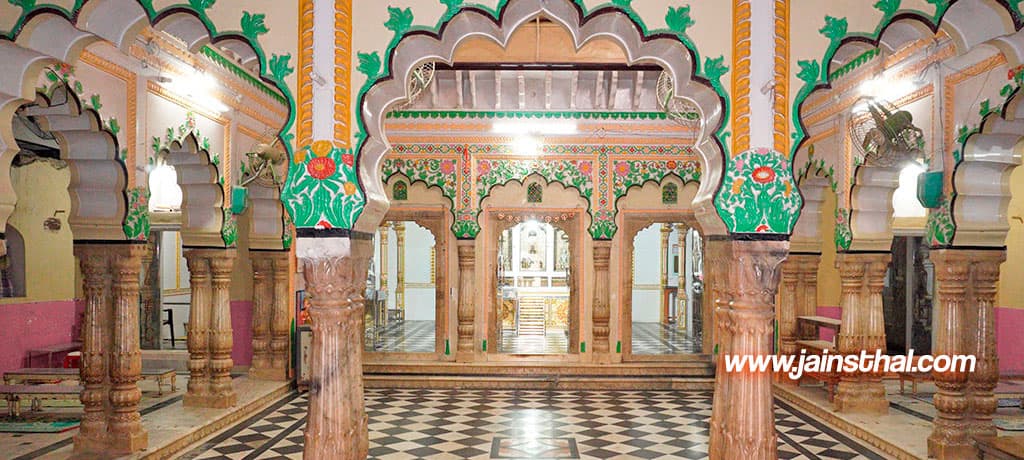
Firozpur Jhirka Chandraparbhu Mandir
About 20 years ago, some small metal idols and the silver Chhatar (brolly) and Bhav Mandal of the temple were stolen, but the Moolnayak Pratima (main deity’s idol) of the Jinendra Bhagwan could not be taken.
A committee has been formed for the efficient management of the temple. The active members of the committee are as follows :
Introduction
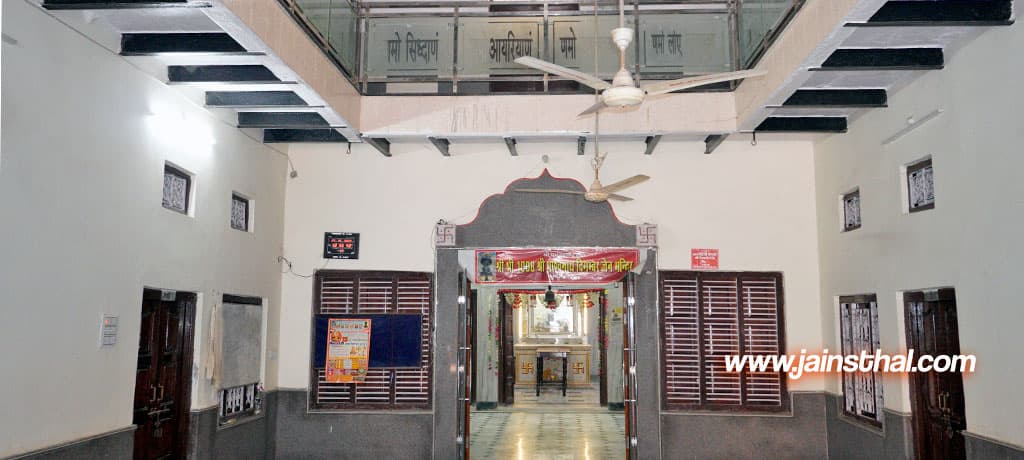
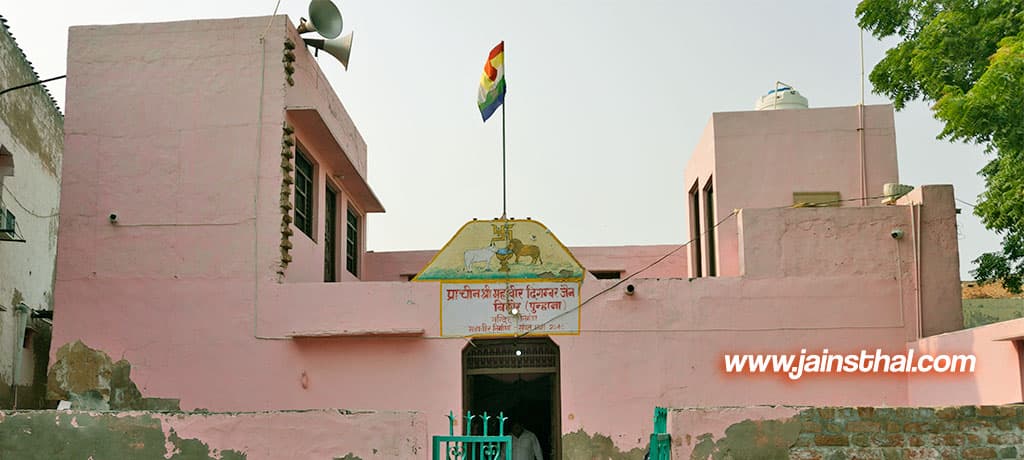
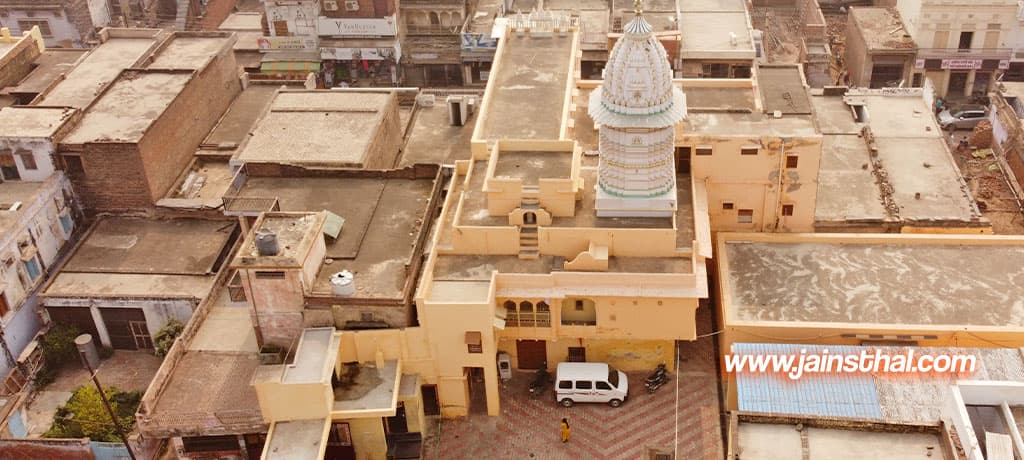
Situated about twenty kilometers away from Dehra Tijara Ji, Firozpur Jhirka houses Shri 1008 Digambar Jain Bada Mandir Ji. Constructed primarily from red stone, Bada Mandir Ji also referred to as Lal Mandir Ji (Red Temple). Within the premises of the present temple, there are two Jain temples, among which the Shri 1008 Parshvanath Digambar Jain Mandir is approximately 450 to 500 years old, while the Shri 1008 Chandraprabhu Digambar Jain Mandir is around 250 years old. The construction of the Shri 1008 Chandraprabhu Digambar Jain Mandir in Garh Bhitar took place approximately 250 years ago due to the increasing number of devotees visiting the Shri 1008 Parshvanath Digambar Jain Lal Mandir Ji. Over time, renovations have been ongoing in the temple. The Mool (main) Vedi of the temple belongs to Shri 1008 Chandraprabhu Bhagwan.
“About 20 years ago, some small metal idols and the silver Chhatar (brolly) and Bhav Mandal of the temple were stolen, but the Moolnayak Pratima (main deity’s idol) of the Jinendra Bhagwan could not be taken.”
Idols in the second and third Vedi were enshrined during the Revari Panchkalyanak (consecration ceremony) in 2005-2006. The Moolnayak Pratima in the second Vedi belongs to Shri Parshvanath Bhagwan, established in memory of Shri Munshilal Jain by Shri Murarilal Jain. The third Vedi was constructed by the family of Shri Tarachand Ji, in the Vedi the Moolnayak Pratima is of Shri 1008 Neminath Bhagwan Ji. Along with the Moolnayak Pratima, other Jain idols are enshrined in the Vedi. Due to the increasing number of devotees visiting daily, the hall of the temple has also been expanded.
Atishay Katha
It is said by the Jain community that while the Siddhachakra Vidhan was being performed in the temple, there was a need for security for the gold and silver in the temple. Vyas Ji was responsible for the security of the gold and silver in the temple, so he used to sleep in the courtyard of the temple at night. One night, while he was asleep, his feet were towards the Vedi of the temple. At around two-thirty in the night, a person came and woke him up. Seeing the person at such a late hour, Vyasa Ji felt alarmed, but the person assured him that there was no need to fear. He just wanted to advise Vyasa Ji not to keep his feet towards the Vedi of the temple. One should never point their feet towards the Vedi of the temple. Upon hearing this advice, Vyasa Ji moved his feet away from the Vedi and in the morning he shared this incident with the Jain community.
Dharamshala
In Firozpur Jhirka there is a Jain community of approximately 150 families. The Jain community actively participates in all activities at the temple with great enthusiasm. Special attention is given to the cleanliness for the devotees who come for daily worship and rituals at the temple. Arrangements are made by the Jain community for pilgrims, coming from distant areas to visit the temple.
In 1996, the Samadhi of Jain Muni Shri 108 Gyanbhushan Ji’s guru, Shri 108 Shantisagar Ji, took place in Firozpur Jhirka. It was his wish that a school be built for the education of girls from economically weaker sections of the society. In fulfillment of his wish, the Jain community laid the foundation of Jain Girls School in 1996. By 1999, the school was ready, and it was named Shri Shanti Sagar Jain Girls College. Later, a Jain High School was also constructed within its premises.
History
Firozpur Jhirka is a town located in the Nuh district of the Indian state of Haryana. Nuh district is one of the 22 districts of Haryana, covering an area of 1,860 square kilometers (720 square miles) with a population of 1.09 million. It is bordered by Gurgaon district to the north, Rewari district to the west, and Faridabad and Palwal districts to the east. This area is predominantly inhabited by Muslims. It represents the modern southern part of Haryana and northeastern Rajasthan. Mewat region has several hills of the Aravalli mountain range. It was famous for its aggressive character of its inhabitants for many centuries, who repeatedly troubled the Turkish, Pathan, Mughal, and British rulers in Delhi. During the Mughal era, Mewat became a part of the Delhi and Agra provinces. Its most famous cities were Narnaul, Kotila, Indore, Alwar, Tijara, and Rewari. Agriculture is the main occupation in the district, along with trade-related and agriculture-based activities. Animal husbandry, especially dairy farming, is a significant source of income for people, and those living near the Aravalli mountain range also keep sheep and goats.
Know something about this temple?
Spot something missing or incorrect, or have extra info to share? Let us know and our team will take a look.
A committee has been formed for the efficient management of the temple. The active members of the committee are as follows :