
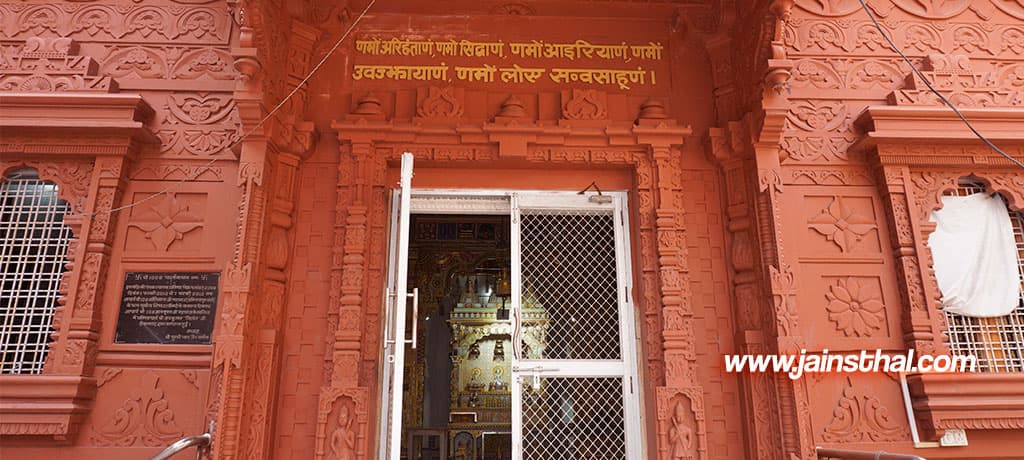
Firozpur Jhirka Laal Mandir
Every day, members of the Jain community visit the temple to see the pratima and seek blessings for their well-being.
A committee has been formed for the smooth functioning of the temple. The active members of the committee are as follows :
Introduction
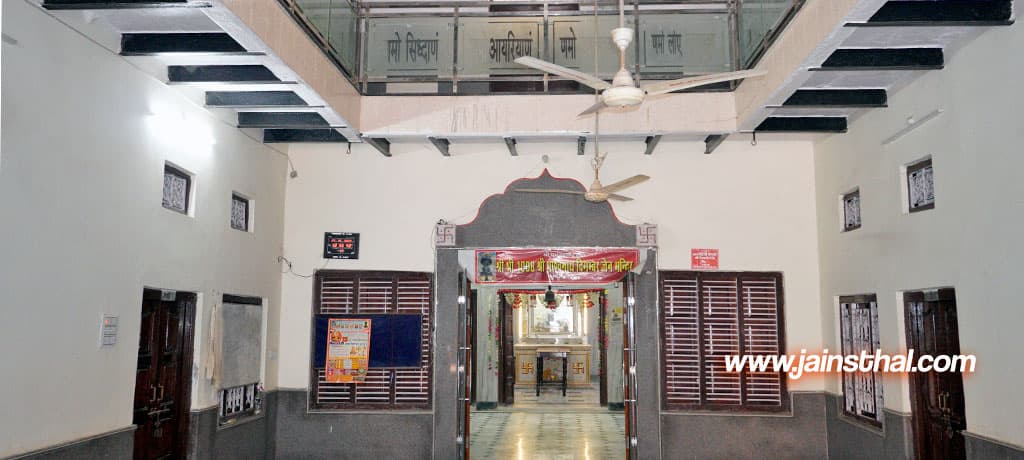
Situated about twenty kilometers away from Dehra Tijara Ji, Firozpur Jhirka houses Shri 1008 Digambar Jain Bada Mandir Ji. Constructed primarily from red stone, Bada Mandir Ji also referred to as Lal Mandir Ji (Red Temple). Within the premises of the present temple, there are two Jain temples, among which the Shri 1008 Parshvanath Digambar Jain Mandir is approximately 450 to 500 years old, while the Shri 1008 Chandraprabhu Digambar Jain Mandir is around 250 years old. The temple was built by the Jain community approximately 450 to 500 years ago. Initially, the Garbh Grah (sanctum sanctorum) of the temple was in the form of a Chaityalaya. In the year 2010, Acharya Shri Gyanbhushan Ji Maharaj visited the temple. Upon observing the condition of the temple, he suggested its renovation to the community. In the same year, with the presence of Acharya Shri Gyan Bhushan Ji Maharaj, the renovation of the temple took place. By constructing Shikhar (spire) along with the Panchkalyanak (consecration ceremony) of idols, the Chaityalaya was transformed into a temple. Initially, there were three idols in the temple's Vedi (altar), in which the Moolnayak Pratima (main deity’s idol) is of Shri 1008 Parshvanath Bhagwan Ji. Alongside the Moolnayak Pratima, idols of Shri 1008 Chandraprabhu Bhagwan and Shri 1008 Shantinath Bhagwan were also present. After the Panchkalyanak conducted by Jain families in 2010, idols made of Ashtadhatu (eight metals) of Shri 1008 Adinath Bhagwan and Shri 1008 Mahavir Bhagwan were also placed in the Vedi. The walls and the Vedi of the temple were decorated with beautiful gold work, providing a sense of peace to those who witnessed it.
“Every day, members of the Jain community visit the temple to see the pratima and seek blessings for their well-being.”
It is told by the local Jain community that 70 years ago, there was a family that was affluent in every way. One day, some members of the family moved the idols of this temple to the Vedi of another temple without consulting anyone and completed the act themselves. Soon after, tensions started to rise within their family, and all their prosperity gradually diminished. After some time, some members of that family left the area and settled in Delhi and Uttar Pradesh. Later, some members of the family returned to the temple, acknowledged their mistake out of ignorance, and begged for forgiveness. They reinstated those idols in the Vedi of Shri 1008 Parshvanath Digambar Jain Mandir. Only then did an improvement come to their family financial condition.
Dharamshala
In Firozpur Jhirka, there is an affluent community of around 150 Jain families. The Jain community actively participates in all activities of the temple with great enthusiasm. Complete attention is paid to the cleanliness for the devotees who come to the temple for daily worship and ablutions. If a pilgrim comes to the temple from a distant area, appropriate arrangements are made for them by the Jain community. In the year 1996, the samadhi of Jain Muni Shri 108 Gyanbhushan Ji's Guru, Shri 108 Shantisagar Ji, took place in Firozpur Jhirka. It was his wish that a girls' school should be built for the economically weaker sections of society. His wish was fulfilled by the Jain community in 1996 by laying the foundation of the Jain Girls' School. The school was completed and ready by 1999, and it was named Shri Shanti Sagar Jain Girls' College. Later, a Jain high school was also constructed within its premises.
History
Firozpur Jhirka is a town located in the Nuh district of the Indian state of Haryana. Nuh district is one of the 22 districts in the state of Haryana, covering an area of 1,860 square kilometers (720 square miles) with a population of approximately 1.09 million. It is bordered by Gurgaon district to the north, Rewari district to the west, and Faridabad and Palwal districts to the east. It is predominantly inhabited by the Muslim population. This region is a modern southern part of Haryana and northeastern Rajasthan. There are several mountain ranges of the Aravalli hills in Mewat. It was famous for its aggressive character of its inhabitants for many centuries, who constantly troubled Turkish, Pathan, Mughal, and British rulers in Delhi. During the Mughal era, Mewat became a part of the province of Delhi and Agra. Its most famous cities were Narnaul, Kotila, Indore, Alwar, Tijara, and Rewari. Agriculture is the main occupation in the district, along with trade-related and agriculture-based activities. Animal husbandry, especially dairy farming, serves as a primary source of income for the people, and those living near the Aravalli mountain range also rear sheep and goats.
Know something about this temple?
Spot something missing or incorrect, or have extra info to share? Let us know and our team will take a look.
A committee has been formed for the smooth functioning of the temple. The active members of the committee are as follows :