
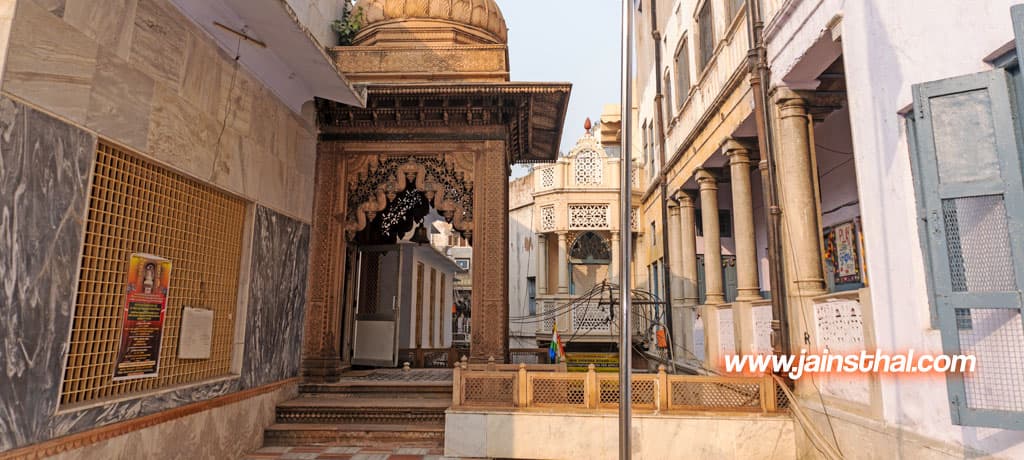
Shri Digambar Jain Naya Mandir, Dharampura
This mysterious and unique feature has persisted over time, emphasizing the temple’s reliance on natural energy and divine illumination.
The temple operates under the Panchayati Committee of Chandni Chowk’s Jain temples. To ensure smooth management and maintenance, a dedicated Manager has been appointed:
Introduction
Shri Digambar Jain Naya Mandir, located in Dharampura, Chandni Chowk, Delhi, holds immense historical, cultural, and religious significance. This ancient temple is approximately 215 years old and is a living symbol of the sacred Jain tradition. The foundation stone of this temple was laid in 1802 by Raja Harsukh Rai, and after seven years of dedicated efforts, the consecration ceremony was completed in 1809. The temple is renowned not only for its unique architecture but also for its deep religious and cultural importance, distinguishing it from other temples.
Many devotees have visited the Atishaykari (miraculous) idol of Shri 1008 Shantinath Bhagwan at Shri 1008 Digambar Jain Bada Mandir in Hastinapur. Interestingly, in the early days of Shri Digambar Jain Naya Mandir, this very miraculous idol was enshrined here as the principal deity before being relocated to Hastinapur. At that time, this idol held great religious and spiritual significance, further enriching the temple’s historical and cultural heritage.
Currently, the principal deity of Shri Digambar Jain Naya Mandir is of Shri 1008 Adinath Bhagwan. The temple houses a total of ten Vedis (altars), with the first dedicated to Lord Mahavir, enshrining gemstone-adorned idols. The second altar features the principal deity, Shri Adinath Bhagwan, while the third is dedicated to Panchmeru. The fourth altar is devoted to Nandishwar Dweep, followed by the Chaubisi Vedi, where the main idol is of Shri Mahavir Bhagwan. Additionally, altars dedicated to Lord Chandraprabhu, another altar for Lord Adinath, and a grand Sahasrakoot Chaityalaya, with 1008 intricately carved idols on a single stone, are also present. The temple also features a separate altar for Lord Mahavir and an altar dedicated to Jinwani Mata. Two years ago, a 21-foot-high Manas Stambh was erected, serving as an inspiration for peace and meditation.
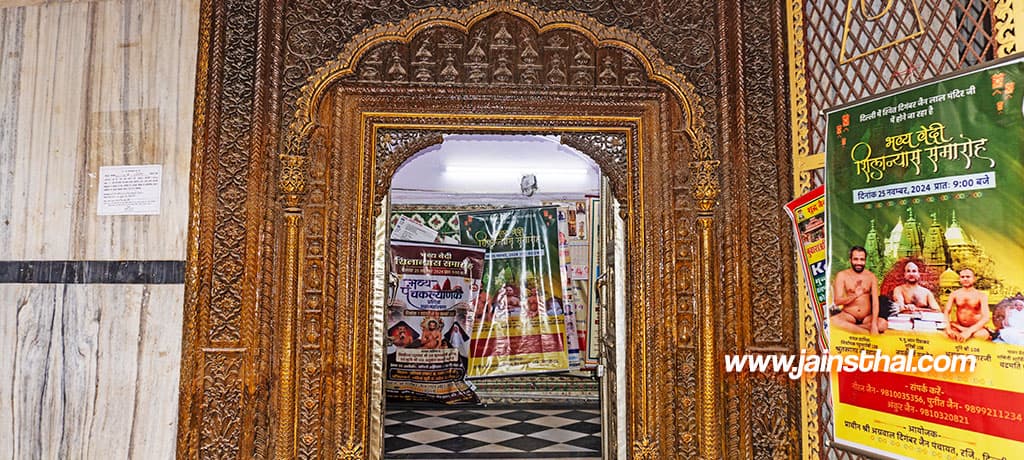
The temple showcases exceptional examples of Jain art, especially on its walls, ceilings, and dome. Unlike conventional paintings, the artwork here uses finely crushed gemstones and gold embellishments instead of traditional colors. This exquisite craftsmanship not only enhances the temple’s visual appeal but also highlights the grandeur of Jain artistry, expressing deep faith and devotion.
The temple also houses ancient and handwritten scriptures, including a special 520-million-syllable Bhaktamar Stotra inscribed in gold letters and sacred palm-leaf manuscripts. Notably, after the renowned Jain temple in Moodbidri, Karnataka, Shri Digambar Jain Naya Mandir is the only temple to possess such sacred palm-leaf scriptures. Another remarkable attraction is a Nav Mantra inscription carved onto a single grain of rice, a testament to intricate craftsmanship and religious reverence.
Pandit Daulatram Ji, a highly respected and honored Jain poet, is also associated with this temple. His major literary masterpiece, the “Chhahdhala Granth,” remains highly revered in Jainism. Born in 1805, he passed away in 1923 at this temple, making it a place of great historical and spiritual significance.
Atishay Katha
This temple is renowned for its extraordinary phenomenon: no artificial lighting or lamps have ever been used here. All religious rituals and ceremonies are conducted solely in natural sunlight. Even attempts to install artificial lighting or electrical appliances have failed due to persistent short circuits.
“This mysterious and unique feature has persisted over time, emphasizing the temple’s reliance on natural energy and divine illumination.”
From 2009 to 2024, over 200 religious ceremonies (Vidhans) have been successfully conducted here.
Jain Samaj
Shri Digambar Jain Naya Mandir is not just a place of worship but also an important center for social and cultural activities within the Jain community. Various religious ceremonies, scriptures recitations, and charitable activities are regularly organized. Since 2009, over 200 religious ceremonies have been successfully conducted at this temple. Major religious festivals such as Dashalakshan Parv, Mahavir Jayanti, the Janaam Kalyanak of Bhagwan Adinath, and Shrut Panchami Mahotsav are celebrated with great enthusiasm.
Apart from religious activities, the community actively engages in social service. Initiatives such as financial aid for underprivileged children, food donation camps, and other humanitarian efforts define the temple’s community outreach. A notable instance of compassion was when the temple safeguarded 124 goats from slaughter during Eid, sending a powerful message of non-violence and kindness, which was widely appreciated.
Approximately 100-200 Jain families reside in the vicinity of the temple, fostering a vibrant Jain community. The surrounding area also includes eight dharamshalas, eight large temples, and six chaityalayas, providing accommodation facilities for pilgrims and Jain Munis (Saints). During the visit of Jain Saints, dedicated accommodations such as Sant Bhavan, dharamshalas, and Muni Niwas caves, along with traditional sanitation facilities, are made available. Additionally, the temple operates a library that preserves and promotes Jain literature and scriptures.
History
The National Capital Territory (NCT) of Delhi is the capital of India and a Union Territory. It houses the headquarters of all three branches of the Indian government: the Executive, the Legislature, and the Judiciary. Situated along the banks of the Yamuna River, Delhi holds a significant place in ancient Indian history, with its roots tracing back to the Indus Valley Civilization. Excavations in Haryana and nearby regions have provided evidence of this historical connection. With the rise of the Delhi Sultanate, the city emerged as a major political, cultural, and commercial hub. The city is home to numerous historical and medieval architectural landmarks.
Delhi is mentioned in the Mahabharata as the ancient city of Indraprastha, which was the capital of the Pandavas. Today, Delhi is not only the political capital of India but also a major tourist destination. As the capital city, it hosts several government offices, including Rashtrapati Bhavan (Presidential Palace), Parliament House, and Central Secretariat, showcasing modern architectural brilliance. Additionally, Delhi's rich history is reflected in its numerous historical landmarks, such as Purana Qila, Safdarjung’s Tomb, Jantar Mantar, Qutub Minar, and the Iron Pillar, which attract tourists worldwide.
The city also features prominent religious sites across various faiths, including Birla Mandir, Katyayani Shakti Peeth, Lal Jain Mandir, Bangla Sahib Gurudwara, the Bahai Lotus Temple, Akshardham Temple, and Jama Masjid. The India Gate, a memorial honoring fallen soldiers, is also located here. In contemporary times, Delhi has become India’s primary commercial and trade center.
Know something about this temple?
Spot something missing or incorrect, or have extra info to share? Let us know and our team will take a look.
The temple operates under the Panchayati Committee of Chandni Chowk’s Jain temples. To ensure smooth management and maintenance, a dedicated Manager has been appointed: