
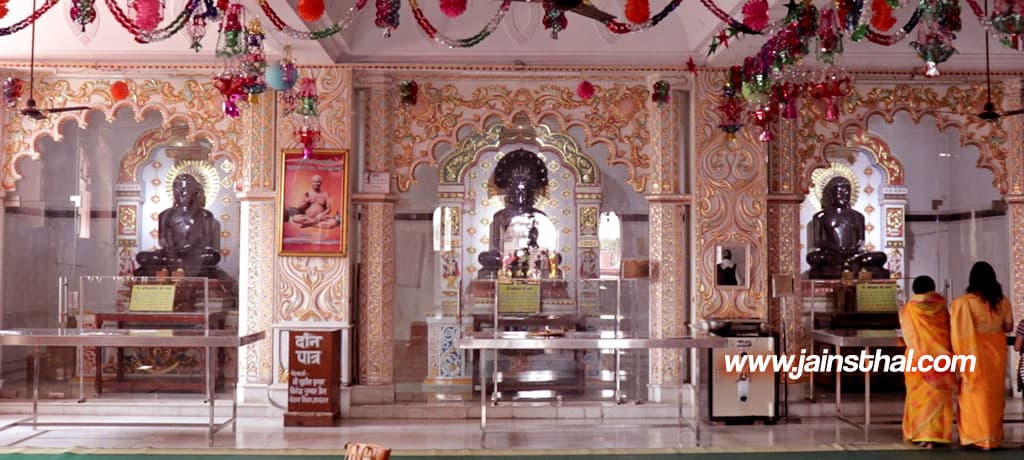
Badagaon Prachin Atishay Kshetra
Astonished, people started digging with their hands.
The management of the Shri Parshvanath Atishay Kshetra, an ancient Digambar Jain Mandir, is undertaken by the Bada Gaon Village Digambar Jain Mandir Committee. The members of the committee are as follows :
Introduction
Baghpat district has been a major center of Jain community's faith since ancient times. Located on the outskirts of the National Expressway-2, Bada Gaon is a prominent village in Baghpat district. Upon entering Bada Gaon from the main road, we come across the premises of two temples. Among them, on the right side, there is an Prachin Mandir, and on the left side, there is a newly constructed Trilok Teerth Dham Mandir. The construction of the Shri 1008 Parshvanath Bhagwan Digamber Jain Prachin Mandir Atishay Kshetra, in Bada Gaon was carried out by the Jain community in 1922. The Moolnayak Pratima (main deity’s idol) enshrined in the temple was obtained during excavation of a mound, while other statues were obtained from a mango orchard near the temple during excavation. The temple has seven Shikhar (spires). The main Shikhar of the temple, which is 101 feet tall, houses the Mool Vedi (main altar) of Shri 1008 Parshvanath Bhagwan. Other idols obtained during excavation have also been enshrined in the Vedi of other Shikhar. The construction of two additional Vedi has also been undertaken in the temple. One is dedicated to Shri 1008 Munisuvratnath Bhagwan, and the other is dedicated to Shri 1008 Chandraprabhu Bhagwan. Construction of another Vedi is also underway in the temple, where a large metal idol of Shri 1008 Parshvanath Bhagwan will be enshrined.
Atishay Katha
During the Mughal rule, temples across India were being destroyed, and people protected the idols by burying them in the ground. Similar instances were observed in Bada Gaon. In ancient times, there was a sand mound known as Parshav Teela. In 1922, the arrival of Shri Elak Anantkirti Ji Maharaj occurred. Upon being informed about the Teela, he meditated there and witnessed a faint glimpse of the deity. Later, he instructed people to excavate the site. After digging about 12 feet deep, a voice was heard saying "Bhaiyo Dheere-Dheere Khudai Karo" meaning brothers, dig slowly.
“Astonished, people started digging with their hands.”
After some time, they found the magnificent idol of Shri 1008 Parshvanath Bhagwan Ji made of white stone. Subsequently, people constructed the temple and enshrined the idol. The well was constructed at the same spot where the idol was found. People use the water from this well for the treatment of their ailments.
Dharamshala
For the convenience of pilgrims coming from afar, a dharamshala has been constructed in the temple complex. The dharamshala consists of 120 AC and 20 non-AC rooms, along with provisions for cooler rooms. A dining hall has also been constructed for sattvic meals. Additionally, there is the Acharya Shri 108 Gyan Sagar Tyagi Bhavan, which serves as a resting place for ascetics and saints. Furthermore, plans are underway to construct a natural healthcare hospital with 74 rooms within the premises.
History
Baghpat is also known as the city of sugarcane fields. Its significance grew after the uprising of 1857. Initially part of Meerut, Baghpat was later designated as a district in 1997. The primary occupation here revolves around the cultivation of jaggery and sugar. Baghpat is home to Trilok Teerth Dham and several other Jain temples. The region's history can be traced back to the time of the Mahabharata, with the presence of the remains of Lakshagriha from that era found in Baraut, a town in Baghpat.
Know something about this temple?
Spot something missing or incorrect, or have extra info to share? Let us know and our team will take a look.



The management of the Shri Parshvanath Atishay Kshetra, an ancient Digambar Jain Mandir, is undertaken by the Bada Gaon Village Digambar Jain Mandir Committee. The members of the committee are as follows :