
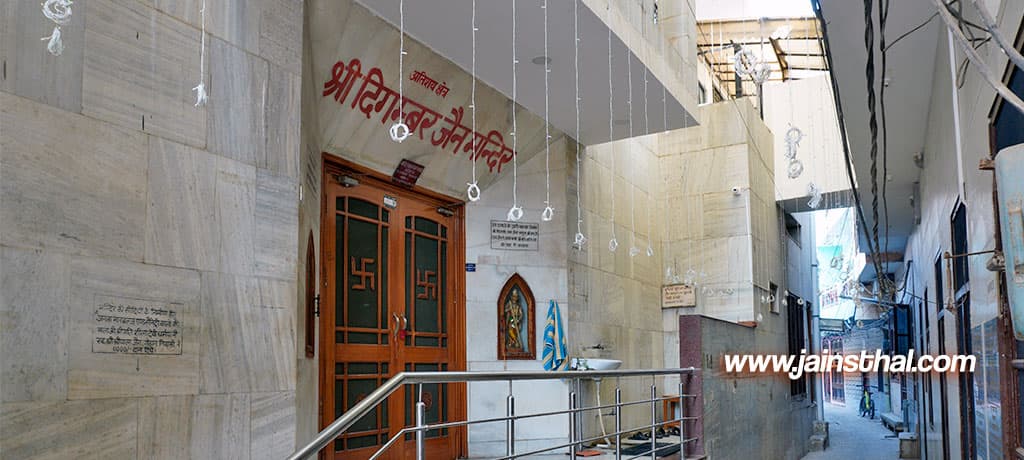
Ambala City Jain Mandir
Shri 1008 Digambar Jain Atishay Kshetra is located in Bans Bazaar, Ambala City, at a distance of one and a half kilometer from Ambala Railway Station.
A temple committee has been formed for the proper management of the temple. The active members of the committee are as follows:
Introduction
“Shri 1008 Digambar Jain Atishay Kshetra is located in Bans Bazaar, Ambala City, at a distance of one and a half kilometer from Ambala Railway Station.”
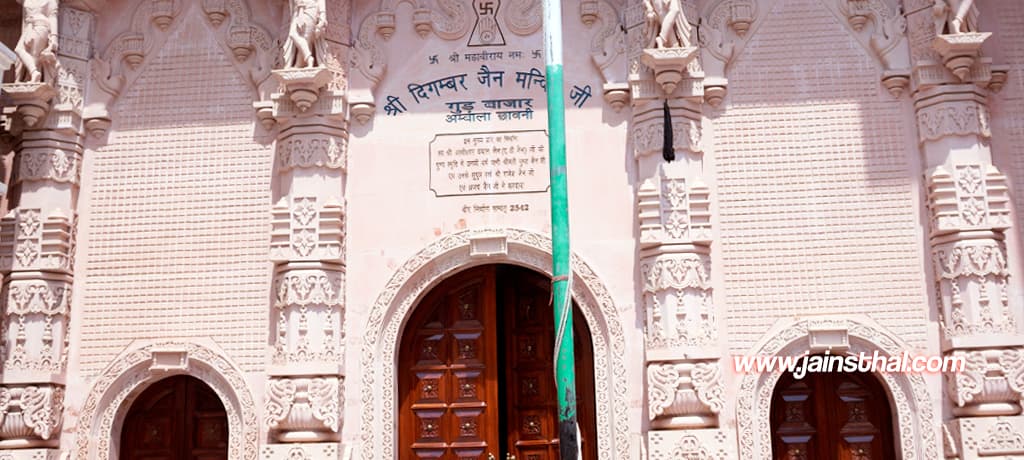
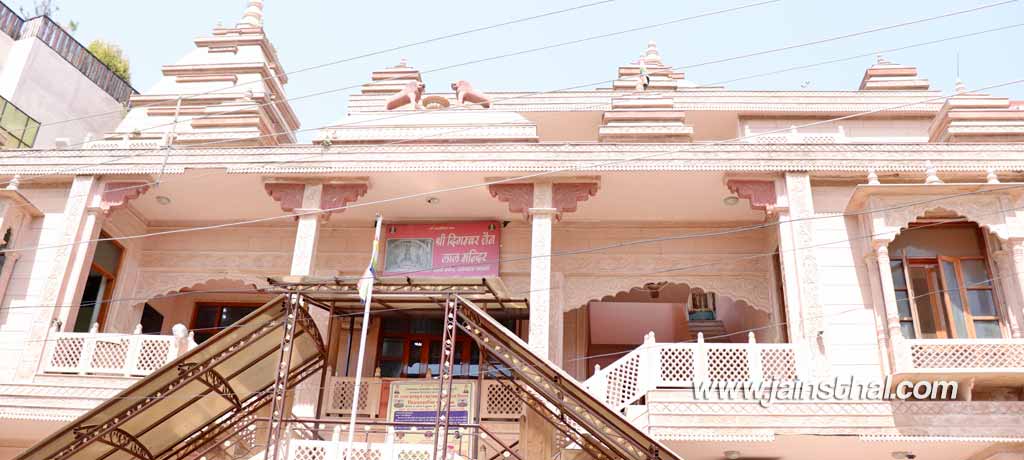
Previously, in place of the temple, there used to be a mansion of the late Lala Kundan Lal Jain Ji. He constructed a Chaityalaya in his residence for the darshan. In the year 1916, the property was handed over to the local Jain community by the late Lala Kundan Lal Jain and his son, Lala Mahatab Rai Jain. In the year 1944, the Jain community renovated the Chaityalaya and converted it into a proper temple structure. In 1974, during the Nirvana Mahotsav of Shri 1008 Mahavir Bhagwan Ji, three Jain idols were discovered during excavation from the basement of the Shri 1008 Suparshwanath Swetambar Jain Temple, located adjacent to the main temple. It was decided by the Swetambar Jain community to establish these idols in the same temple. As the pratima were in the Digambar state, the Digambar Jain community also requested to acquire the idols. After a month long discussion between the committees of both the communities, it was decided to establish the idol of Bhagwan Neminath Ji in the Shwetambar Jain Temple and the idol of Shri Vasupujya Bhagwan and Mata Padmavati Ji in the Digambar Jain Temple. With the consent of both communities, the idols were enshrined in the Digambar and Swetambar Jain temples. Currently, the temple has a total of six Vedi (altar). The Mool (main) Vedi of the temple houses the Moolnayak (principal deity) Shri Adinath Bhagwan’s idol, along with the idol of Shri Shantinath Bhagwan, Shri Parshvanath Bhagwan, Shri Shitalnath Bhagwan, Shri Mahavir Bhagwan, Shri Adinath Bhagwan, and Shri Neminath Bhagwan, as well as the Chaubisi Pratima and Siddha Parameshthi pratima. In addition to the Mool Vedi, two other Vedi houses, the idols of Shri Vasupoojya Bhagwan and Mata Padmavati Ji, which were discovered from the excavation of the basement, are believed to be more than two thousand years old. These idols are worshiped by both the Jain community and people from other communities who visit the temple every Friday. Another Vedi of the temple also houses the idol of Shri Adinath Bhagwan. The establishment of this Vedi was done by Lala Kundan Lal Jain during the time of the construction of the Chaityalaya. Along with the idol of Shri Adinath Bhagwan, other Jain idols are also enshrined in this Vedi. In one of the Vedi of the temple houses the Moolnayak Pratima of Shri Kunthunath Bhagwan is made of Ashtadhatu (eight metals). Along with the Moolnayak Pratima, idol of Shri Ajitnath Bhagwan and Shri Mallinath Bhagwan made of Ashtadhatu, and idol of Shri Adinath Bhagwan made of silver and Shri Mahavir Bhagwan made of gold are also enshrined. In the Garbh Grah (sanctum sanctorum) of the temple, there is also a Navagraha Vedi adorned with crystal pratima. The walls surrounding the Garbh Grah are beautifully adorned with glass paintings depicting Jain stories, major Jain pilgrimage sites, and illustrations of Bhagwan Jinendra's samavsharan. Every day, regular Puja-Prakshal (prayer) and Abhishek (auspicious bath of the idol) are done in the temple.
Dharamshala
The Jain community has also actively contributed to the welfare of society in Ambala. Several Jain saints have visited the city from time to time. Every year, grand processions are organized during Jain festivals in which people from all walks of life participate. There are more than 30 Jain families residing in the area, including followers of the Jain Shwetambar tradition. The Jain community has actively participated in various local activities and undertaken numerous initiatives for the benefit of the local society. The temple has arrangements for fifteen rooms for pilgrims who come to visit for darshan. Additionally, arrangements for meals are also provided for Pilgrims who contact and visit the temple. Alongside the temple, a primary school named "Lord Mahavir Playway World" has been established for young children. Whenever a Jain saint visits the area, arrangements for their stay are made in the school. The school is also managed efficiently by the Jain community.
History
Ambala is divided into two sub-regions known as Ambala City and Ambala Cantt. It is situated on the border of Haryana and Punjab, about two hundred kilometers north of Delhi, the capital city of India, on the Sher Shah Suri Marg (National Highway 1). Ambala City is separated by two rivers, the Ghaggar and the Tangri River. The railway junction of Ambala City is an integral part of Northern India. Ambala City is also known as the city of scientific instruments. It is an important industrial city known for the manufacturing of scientific instruments, sewing machines, blending machines (mixers), as well as cotton ginning, flour mills, and handloom industries. The origin of the name Ambala might be derived from Ambalika of the Mahabharata. In modern times, Ambala is famous for its production of scientific equipment and mixer industries. It is also referred to as the Science City due to its concentration of scientific instrument industries. Nearly 40 percent of India's scientific equipment production takes place in Ambala. Another belief is that there were many mango orchards here, leading to its name being derived from "Amba," meaning mango.
Know something about this temple?
Spot something missing or incorrect, or have extra info to share? Let us know and our team will take a look.
A temple committee has been formed for the proper management of the temple. The active members of the committee are as follows: