
Ahinsa Dharmarth Tirth Ambala
During the travel of Jain Saints from the Jagadhri to Ambala or vice versa, there was no provision for their stay nearby.
For the proper management of the temple, a temple committee has been formed. The active members of the committee are as follows :
Introduction
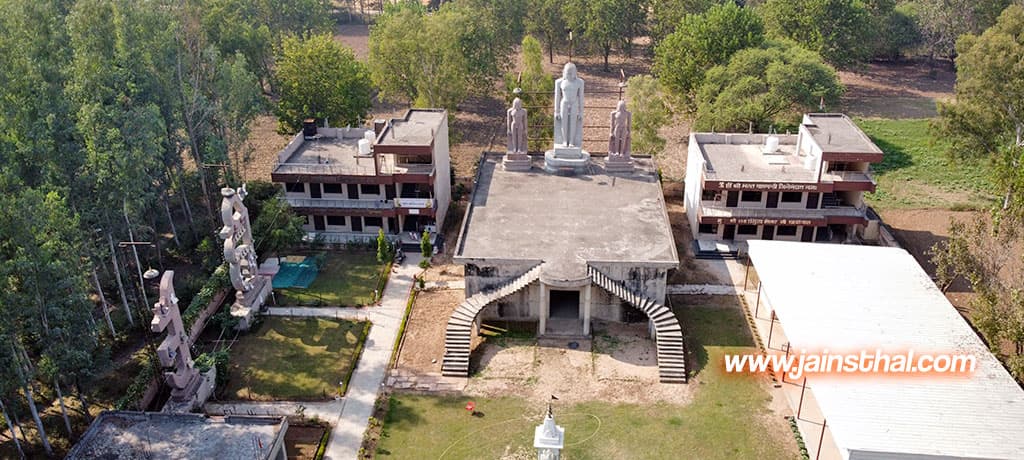
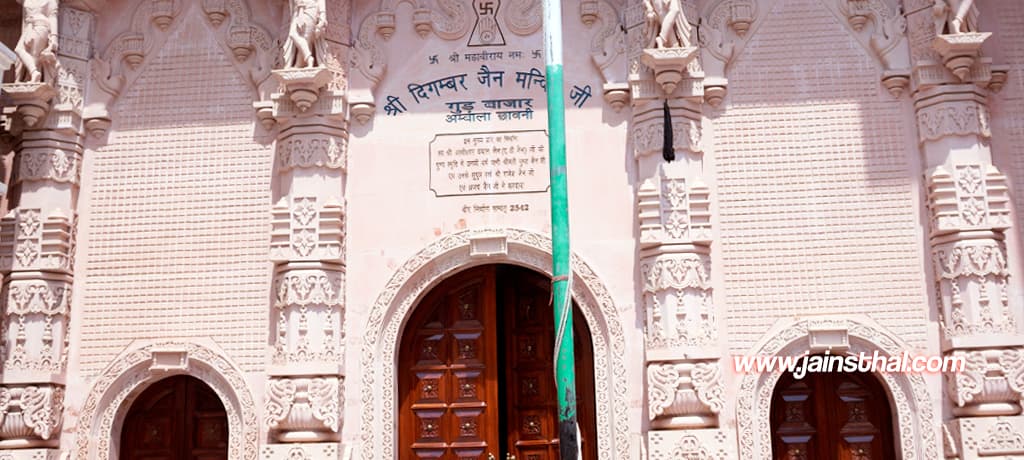
Shri 1008 Digambar Jain Ahinsa Dharmarth Teerth is located on the Jagadhri-Ambala Road, approximately 5.5 kilometers from the city of Ambala Cantt. In the year 2014, Acharya Shri 108 Pramukh Sagar Ji Maharaj's Chaturmas took place in the Bada Jain Mandir situated in Gudbazar, Ambala.
“During the travel of Jain Saints from the Jagadhri to Ambala or vice versa, there was no provision for their stay nearby.”
Therefore Pramukh Sagar Ji Maharaj guided the community to construct an Ahinsa Teerth in the area. With the mutual consent of the local Jain community, it was decided to construct Shri 1008 Digambar Jain Ahinsa Dharmarth Teerth in the same area. The task of providing land for the construction of the Ahinsa Teerth was undertaken by Mr. I.K. Jain, the head of the Ambala Digambar Jain Committee, Gudbazar. The Panchkalyanak (consecration ceremony) of the temple took place in the presence of Acharya Shri 108 Pramukh Sagar Ji Maharaj in the year 2015. The entire area of the temple covers approximately one acre of land. Enhancing the grandeur of the temple, there is a 52-foot tall Manastambh situated within the temple premises. The Manastambha features pratima of 24 Tirthankars. The Moolnayak Pratima (main deity’s idol) of the temple, Shri Adinath bhagwan Ji, stands at a height of 56 feet. Along with the Moolnayak Pratima, there are 32-foot tall idols of Bhagwan Bharat and Bhagwan Bahubali. A Chaityalaya has been constructed within the temple premises, featuring the Moolnayak Pratima of the first Jain Tirthankar, Shri 1008 Adinath Bhagwan Ji. Additionally, a 41-foot tall Om and Hreem (ॐ and ह्रीं) have been constructed within the temple complex. These symbols have been carved from a single stone, with the Hreem containing pratima of the 24 Jain Tirthankars and the Om featuring the Panch Parmeshthi. Below the samadhi site of Acharya Shri, a meditation center has been built within the temple complex. Every day, pilgrims from far and wide visit the temple to witness the idols. Mr. Rakesh, who is actively involved in temple activities, recounts that while he was working on something, he saw a black snake near the meditation center within the temple premises. The snake was approximately five feet long. As he approached the snake near the wall adjacent to the meditation center and took a picture with his mobile phone, the snake disappeared from there. When he looked at the picture on his mobile phone, he was astonished because there was no snake in the picture. Despite this, he has seen the snake several times, but no harm has ever been caused by the serpent deity to anyone. He believes that it is not a snake but our guardian deity.
Dharamshala
The Jain community in Ambala has actively contributed to the welfare of society without a doubt. The construction of the Shri 1008 Digambar Jain Ahimsa Dharmarth Teerth area on the Ambala-Jagadhri Main Road has been undertaken by the Jain community. The construction of the temple has brought a unique energy to the Jain community. People from distant areas come to visit the temple. The Jain Temple Committee has arranged for all kinds of facilities for the pilgrims visiting the temple. Accommodation facilities with fifteen rooms have been constructed for pilgrims who wish to stay. If any pilgrim contacts and arrives at the temple, arrangements like meals are also made available. Additionally, a renunciation building and meditation center have been constructed within the temple premises. A beautiful garden has been developed in the temple complex where more than five hundred people can gather together to listen to discourses during special events or on the arrival of revered saints.
History
Ambala is divided into two sub-regions known as Ambala City and Ambala Cantt. It is situated on the border of Haryana and Punjab, about two hundred kilometers north of Delhi, the capital city of India, on the Sher Shah Suri Marg (National Highway 1). Ambala City is separated by two rivers, the Ghaggar and the Tangri River. The railway junction of Ambala City is an integral part of Northern India. Ambala City is also known as the city of scientific instruments. It is an important industrial city known for the manufacturing of scientific instruments, sewing machines, blending machines (mixers), as well as cotton ginning, flour mills, and handloom industries. The origin of the name Ambala might be derived from Ambalika of the Mahabharata. In modern times, Ambala is famous for its production of scientific equipment and mixer industries. It is also referred to as the Science City due to its concentration of scientific instrument industries. Nearly 40 percent of India's scientific equipment production takes place in Ambala. Another belief is that there were many mango orchards here, leading to its name being derived from "Amba," meaning mango.
Know something about this temple?
Spot something missing or incorrect, or have extra info to share? Let us know and our team will take a look.
For the proper management of the temple, a temple committee has been formed. The active members of the committee are as follows :